
I’m Ahsan, founder of I Love Online Tool based in Lahore, Pakistan.
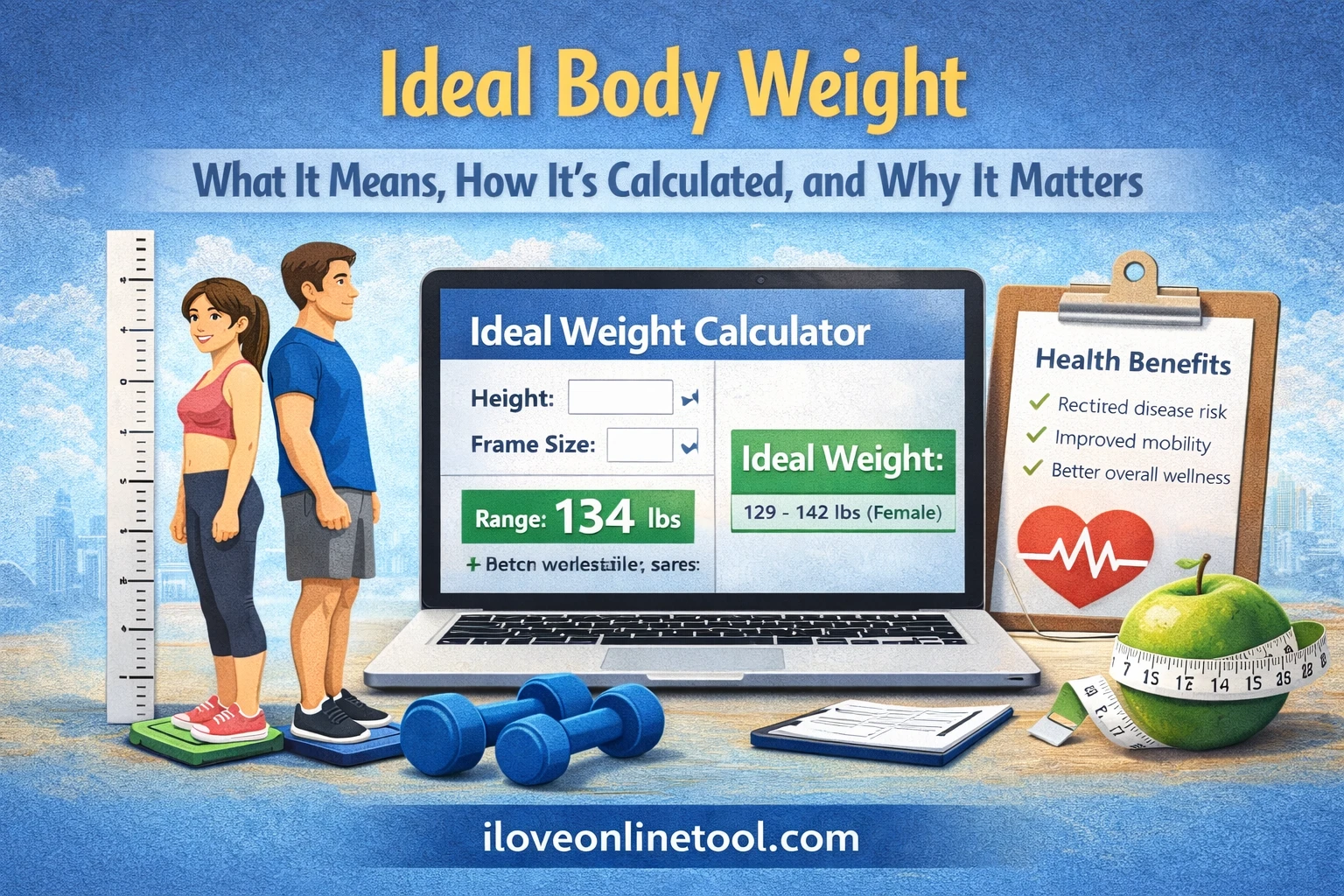
“Ideal body weight” is a phrase that gets used a lot — in fitness advice, health articles, and medical contexts. But what does it actually mean? Is it the same as a healthy weight? Is it the same as your BMI target? Is it a specific number or a range?
This post answers those questions clearly and honestly, explains the formulas behind ideal body weight calculations, and helps you understand how to use this information practically without obsessing over a single number.
What Ideal Body Weight Actually Means
Ideal body weight (IBW) is a medical concept that was originally developed to help calculate appropriate medication dosages based on a person’s size. It was not originally designed as a fitness or beauty target — it was a clinical tool.
Over time it became used more broadly in health contexts to give people a general target weight range based on height and gender. The key word here is “range” — not a single precise number.
IBW represents the weight at which your body is estimated to function most efficiently given your height — where your organs, joints, and metabolism face the least strain. It is a physiological target not a cosmetic one.
How Ideal Body Weight Is Calculated
Several different formulas exist for calculating IBW. Here are the most commonly used ones in medical and health contexts:
Devine Formula (most widely used in clinical settings)
- Men: IBW (kg) = 50 + 2.3 × (height in inches − 60)
- Women: IBW (kg) = 45.5 + 2.3 × (height in inches − 60)
Hamwi Formula
- Men: IBW (kg) = 48 + 2.7 × (height in inches − 60)
- Women: IBW (kg) = 45.5 + 2.2 × (height in inches − 60)
Robinson Formula
- Men: IBW (kg) = 52 + 1.9 × (height in inches − 60)
- Women: IBW (kg) = 49 + 1.7 × (height in inches − 60)
Each formula gives a slightly different number because they were developed in different research contexts. None of them is definitively “correct” — they are all estimates. The range across formulas for a given individual is usually small enough that the differences are not practically significant.
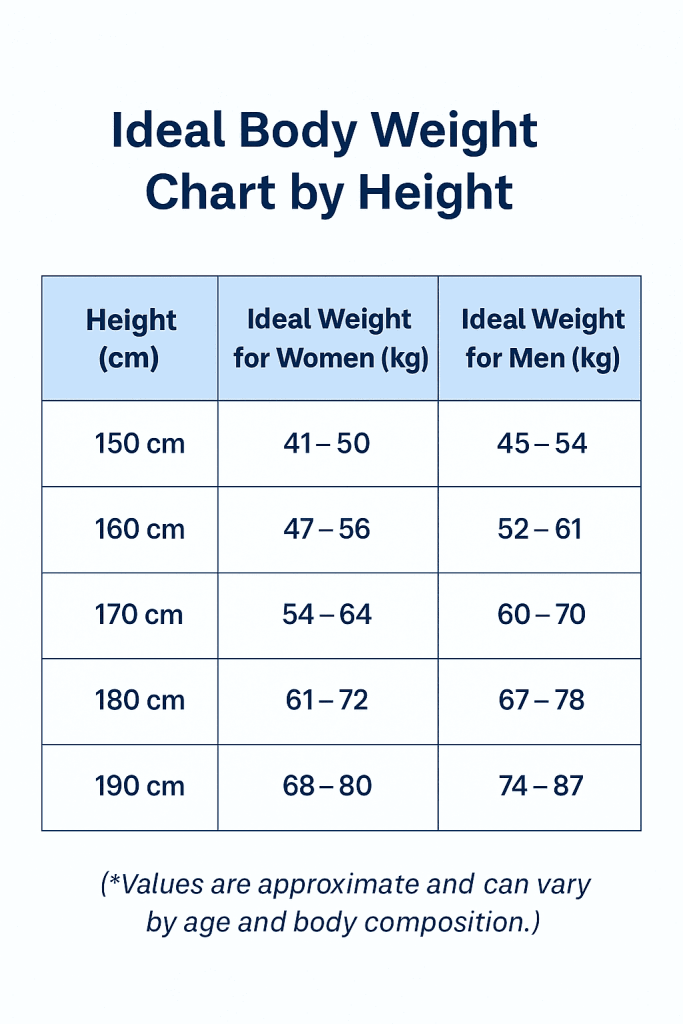
IBW Reference Chart by Height
Here is a general reference for approximate ideal weight ranges by height for adults:
| Height | Women (approx.) | Men (approx.) |
|---|---|---|
| 150 cm | 41 – 50 kg | 45 – 54 kg |
| 160 cm | 47 – 56 kg | 52 – 61 kg |
| 170 cm | 54 – 64 kg | 60 – 70 kg |
| 180 cm | 61 – 72 kg | 67 – 78 kg |
| 190 cm | 68 – 80 kg | 74 – 87 kg |
These are general approximations. Individual factors including bone density, muscle mass, age, and body frame size mean your personal ideal range may differ somewhat from these figures.
The Difference Between IBW and BMI
People often confuse these two and they are related but different.
BMI (Body Mass Index) tells you where your current weight stands relative to your height — whether you are underweight, healthy weight, overweight, or obese. It describes your current status.
IBW (Ideal Body Weight) gives you a target — the weight range your height and gender suggest would be optimal for your body. It describes a goal or reference point.
For most people who are not highly athletic, IBW and the healthy BMI weight range overlap closely. But an athlete with significant muscle mass might have a current weight above their IBW without having excess fat — because IBW doesn’t account for muscle composition.
The most useful approach is to use both as reference points together rather than relying on either one alone. You can check your current BMI using our BMI Calculator alongside IBW for a more complete picture.
How to Use Ideal Body Weight Information Sensibly
Here is where most people go wrong with IBW — they treat it as a verdict rather than a reference point.
Your IBW is a calculation based on height and gender. It does not know your muscle mass, bone structure, age, fitness level, or health history. Two people of identical height and gender can have meaningfully different healthy weights based on these individual factors.
Use IBW as a starting point for a conversation — with yourself about your habits, or with a healthcare professional about your goals. Don’t use it as a strict target that you must hit or as a source of anxiety if you fall outside it.
Practical Tips for Moving Toward Your Ideal Weight
If your current weight is meaningfully above your IBW, here are sustainable approaches that actually work over time:
Focus on habits not targets — Weight changes as a result of consistent habits. Focusing on eating better and moving more consistently will naturally move your weight in the right direction over months. Focusing obsessively on a target number often creates stress that undermines the habits.
Eat more whole foods — Vegetables, lentils, whole grains, lean protein, fruits, nuts. These foods are filling, nutritious, and naturally support weight management without counting every calorie.
Move regularly — 30 minutes of walking daily makes a real difference over months. You don’t need an intense gym programme — consistency matters far more than intensity.
Sleep properly — Poor sleep disrupts hormones that regulate hunger and metabolism. Seven to eight hours of quality sleep is genuinely important for weight management.
Be patient — Healthy, sustainable weight loss happens at roughly 0.5 to 1 kg per week. Anything faster usually means losing muscle or water rather than fat — and it rarely lasts.
Related Tools for a Complete Health Picture
- BMI Calculator — Check your current Body Mass Index
- Height & Weight Calculator — Find your healthy weight range based on height and gender
- Food Cure Hub — Educational information about foods that support health naturally
Frequently Asked Questions
Does ideal body weight change with age? The formulas themselves don’t change with age but the context does. As people age, muscle mass naturally decreases and body composition shifts. An older adult’s IBW may be appropriately slightly higher than the formula suggests to account for this.
Is IBW the same for men and women of the same height? No. Men and women have different body composition — men typically carry more muscle mass and women carry more essential fat. IBW formulas account for this with gender-specific calculations.
Can athletes use IBW as a target? Athletes with high muscle mass will often have a current weight above their IBW without any health concern — because the formula doesn’t account for muscle. For athletes a body fat percentage measurement is more meaningful than IBW.
How accurate are IBW formulas? They provide a reasonable estimate for most average adults. They are less accurate for the very tall, very short, highly muscular, elderly, or pregnant individuals.
What should I do if my weight is significantly above my IBW? Focus on sustainable lifestyle changes — consistent exercise and a whole food diet — rather than crash approaches. If you have specific health concerns speak with a doctor or registered nutritionist.
⚠️ Health Disclaimer
All content in this article is provided for general educational purposes only. Ideal body weight calculations are estimates based on standard formulas and do not account for individual factors including muscle mass, bone density, age, or medical conditions. This content is not intended as medical advice, diagnosis, or treatment. Always consult a qualified healthcare professional before making significant changes to your diet, exercise routine, or health management plan.
About the Author
Written by Ahsan — Founder of I Love Online Tool, based in Lahore, Pakistan. Ahsan is a digital tools developer and educational content writer who builds free, practical online utilities for students, professionals, and everyday users. All content on this platform is written and personally reviewed by Ahsan for accuracy, responsibility, and genuine usefulness.
📧 support@iloveonlinetool.com | 🌐 iloveonlinetool.com
