I’m Ahsan, the founder of I Love Online Tool. I’m based in Lahore, Pakistan, and I built the unit converter on this platform because I kept seeing the same problem — people either obsessing over a single number on the scale or completely ignoring their weight until a health issue made them pay attention.
Neither approach is ideal.
The question “What is a healthy weight for my height?” is one of the most searched health questions online. And the honest answer is: it depends on more than just a single number. This post breaks down what a healthy weight actually means, how our free calculator works, and how to use the result sensibly — without stress or overthinking.
Why Weight Alone Doesn’t Tell You Much
Here’s something worth understanding before you even open a calculator.
Your weight on a scale is just a number. It doesn’t tell you how much of that weight is muscle, fat, water, or bone. It doesn’t account for your height, your age, or your gender. Taken alone, it is essentially meaningless as a health indicator.
That’s why we always look at weight alongside height. A person standing at 180 cm and weighing 80 kg has a very different health profile from someone standing at 155 cm at the same weight. Context changes everything.
What “Healthy Weight” Actually Means
A healthy weight is not a single magic number. It’s a range.
Health organizations like the World Health Organization define healthy weight ranges based on the relationship between height and weight — what’s commonly known as BMI (Body Mass Index). These ranges represent the weights at which most adults of a given height face the lowest average risk of weight-related health problems.
Here’s the standard adult healthy weight range breakdown:
Below 18.5 BMI — Underweight. May indicate nutritional needs worth addressing.
18.5 to 24.9 BMI — Healthy weight. The range associated with the lowest average health risks.
25.0 to 29.9 BMI — Overweight. Above the optimal range but not necessarily immediately dangerous. Lifestyle habits matter most at this stage.
30.0 and above BMI — Obese. Associated with an increased risk of certain health conditions. Medical guidance is recommended.
These are guidelines — not labels. They help you understand where you stand, not define who you are.
How Our Free Unit Converter Works
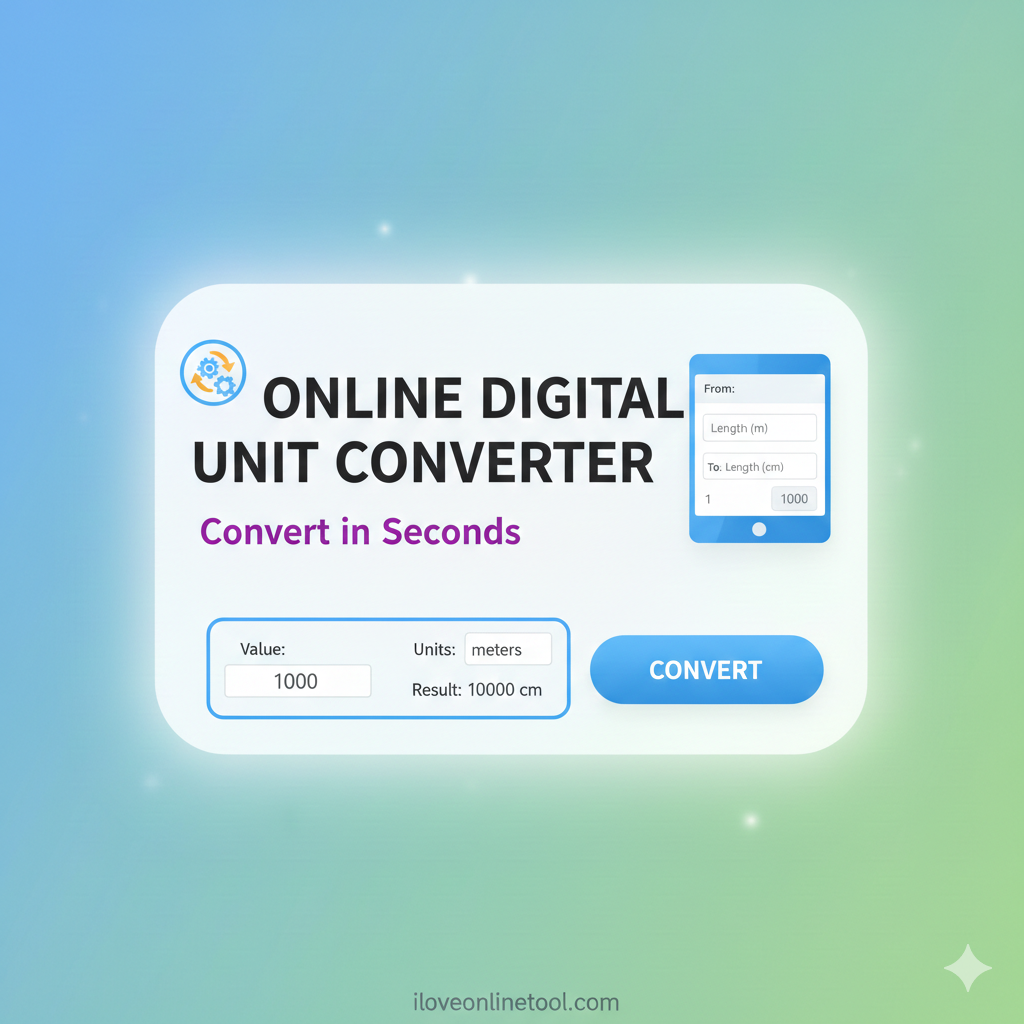
Our Unit Converter is a free online tool that lets you switch between different units of measurement instantly. No formulas to remember. No calculations to do by hand. Just enter a value, choose your units, and get your answer in seconds.
Whether you are a student working on a science assignment, a professional dealing with international measurements, or someone who just needs to quickly convert kilograms to pounds before a grocery run, this tool is built for you.
What You Can Convert
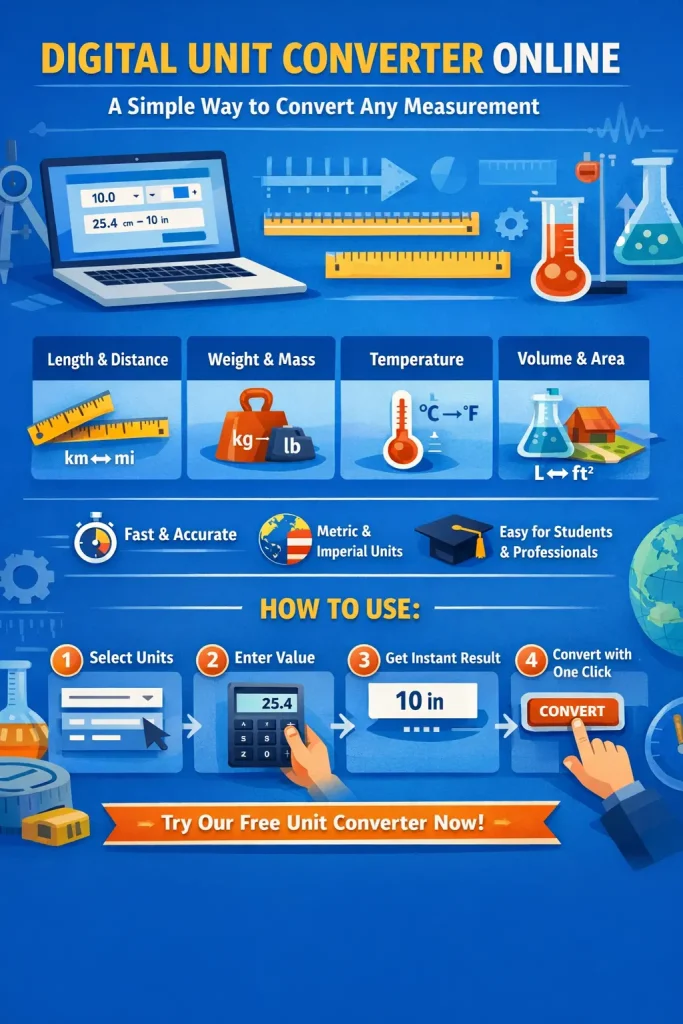
Our unit converter covers the most commonly needed measurement types all in one place:
Length & Distance — Convert between meters, feet, inches, centimeters, kilometers, miles, and yards. Useful for travel, construction, and academic work.
Weight & Mass — Switch between kilograms, pounds, grams, ounces, and metric tons. Helpful for cooking, fitness, and shipping calculations.
Temperature — Convert between Celsius, Fahrenheit, and Kelvin accurately. Essential for cooking, weather, and science.
Volume — Convert liters, milliliters, gallons, fluid ounces, and cups. Great for recipes, chemistry, and liquid measurements.
Area — Switch between square meters, square feet, acres, and hectares. Useful for real estate, farming, and architecture.
Speed — Convert km/h, mph, and meters per second. Handy for travel and physics calculations.
Pressure — Switch between pascals, bar, psi, and atmospheres. Used in engineering and science.
How To Use This Tool
Using the converter is as simple as it gets:
Step 1 — Select the type of measurement you want to convert (Length, Weight, Temperature, etc.)
Step 2 — Enter your value in the input field
Step 3 — Choose the unit you are converting FROM and the unit you want to convert TO
Step 4 — Your result appears instantly
No signup. No fees. No download. Works on mobile and desktop equally well.
Why Metric and Imperial Units Are Both Still Used
One of the biggest reasons people need a converter is that two major measurement systems exist in the world today — the metric system and the imperial system — and they don’t always match.
Most countries use the metric system (meters, kilograms, liters). The United States still primarily uses the imperial system (feet, pounds, gallons). When you shop internationally, read a foreign recipe, or work with global data, you’ll run into both systems regularly.
That’s exactly what this tool solves. You don’t need to memorize any conversion factor. Just use the converter and get on with your work.
Who Uses This Tool?
Students — Physics, chemistry, and math assignments constantly require unit conversions. This tool gives instant, reliable answers without manual calculation errors.
Professionals — Engineers, architects, and data analysts often work across both metric and imperial systems, especially in international projects.
Cooks & Bakers — Recipes from different countries use different units. Converting cups to grams or Fahrenheit to Celsius becomes effortless.
Travelers — Converting miles to kilometers, Fahrenheit to Celsius, or pounds to kilograms are everyday needs when traveling abroad.
Fitness Enthusiasts — Tracking weight in kg vs lbs, or measuring distances in miles vs kilometers, depending on which app you use.
Common Quick Reference Conversions
Here are a few conversions people look up most often — our tool handles all of these and much more:
1 kilometer = 0.621 miles
1 kilogram = 2.205 pounds
1 liter = 0.264 US gallons
0°C = 32°F (freezing point)
100°C = 212°F (boiling point)
1 inch = 2.54 centimeters
1 pound = 453.6 grams
Other Free Tools on This Platform
If you found the Unit Converter useful, you might also want to try our other free tools:
- BMI Calculator — Check your Body Mass Index instantly
- Word Counter — Count words, characters, and sentences in real time
- Height & Weight Calculator — Find your healthy weight range
- Food Cure Hub — Explore food-based health information
All tools are completely free. No registration required.
Frequently Asked Questions
Is this unit converter free?
Yes, 100% free. No account, no subscription, no hidden fees of any kind.
Does it work on mobile?
Absolutely. The tool is fully responsive and works just as well on a phone or tablet as it does on a desktop.
How accurate are the conversions?
The tool uses standard internationally accepted conversion factors. Results are accurate for everyday, academic, and most professional use.
Can I convert more than one thing at a time?
You can switch between different measurement types using the category selector — just choose a new type and enter your next value.
What if I need a very specialized scientific unit?
This tool covers the most commonly used units across all major categories. For highly specialized scientific or engineering units, we recommend consulting a technical reference alongside this tool.
About the Author
Written and maintained by Ahsan — Founder of I Love Online Tool, based in Lahore, Pakistan. Ahsan builds free, practical online tools for students, professionals, and everyday users. All tools and content on this platform are developed and reviewed personally by Ahsan for accuracy and usefulness.
📧 support@iloveonlinetool.com | 🌐 iloveonlinetool.com
