
The first site I ever tried to “fix” for E-E-A-T, I made worse. True story. I’d read a handful of guides, panicked, and stuffed credentials and disclaimers into every corner like that alone would do it. Looked desperate. Performed worse. Took me a while to figure out that improving E-E-A-T isn’t about bolting on trust signals. It’s about actually being more trustworthy, then letting the page show it.
Since then I’ve done this on a lot of sites. Some mine, plenty of clients’. And the stuff that moves the needle turned out to be simpler, and slower, than the panic-version I started with.
So if you’re wondering how to improve E-E-A-T without the flailing I went through, here’s the real list. Twelve steps, in roughly the order I’d tackle them, all things I’ve actually used rather than copied off another guide. Some you’ll knock out in an afternoon. A couple take months. None of them require a budget you don’t have.
Let me walk you through it.
Quick Refresher: What E-E-A-T Even Means
Fast version, because you probably already half-know this. E-E-A-T stands for Experience, Expertise, Authoritativeness, and Trust. It’s the framework Google’s quality raters use to judge whether content, and the people behind it, deserve to be believed. Trust sits at the middle of it. The other three feed into that.
Worth saying once, clearly: there’s no E-E-A-T dial inside Google you can crank. You can’t “set” your score. What you can do is genuinely become the kind of source the framework describes, and these twelve steps are how you get there. That’s the whole game. Be worth trusting, then make it obvious.
One more framing before we start, because it’ll save you from my early mistake. These steps split roughly into two buckets. The fast ones you can knock out this week, mostly about making your existing credibility visible. And the slow ones that build over months, mostly about earning credibility you don’t have yet. Do the fast ones first. They give you momentum and a quick lift, which keeps you going long enough to do the slow ones that really compound.
Right. The steps.
1. Put a Real, Named Human on Every Page
This is the one I’d start with every single time, because it’s fast and the payoff is huge. So much content online has nobody behind it. No name, no face, no hint of who’s talking. That’s an instant trust gap.
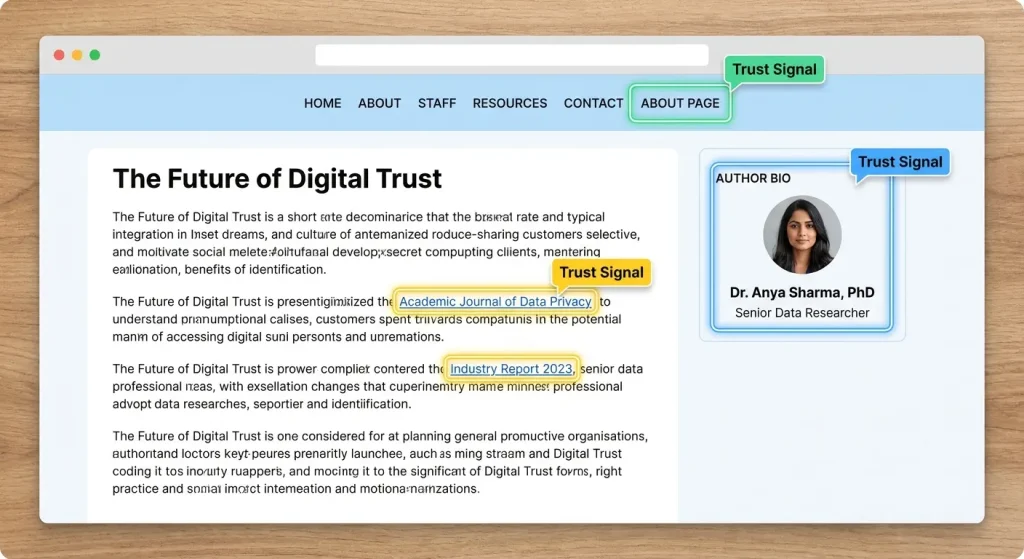
Give every article a real author. Not “admin.” Not “the team.” An actual person with a name. Then back it with a short bio that says why they’d know anything about the topic. I’ve watched this single change shift how a site feels almost overnight, because suddenly there’s a human being accountable for the words.
What goes in the bio matters more than its length. Skip the fluff. One or two lines on who the person is and the specific reason they’re worth listening to on this subject beats a paragraph of generic puffery. I had a client whose articles were genuinely solid but bylined to nothing. We added a real author, a photo, a two-line bio tying them to the niche, and nothing else changed. The content read more credible immediately. Same words, different weight. That’s the whole point. A reader needs someone to trust, and an empty byline gives them no one.
2. Build Out Your About and Contact Pages
Nobody loves writing these. Do it anyway. Your About page is where a skeptical reader (or a quality rater) goes to decide if you’re legit. A thin, two-sentence About page says “fly-by-night.” A real one, who you are, what you do, why this site exists, says “someone’s actually home.”
Same with Contact. A working way to reach you, a real address or at least a real email, the boring stuff. It signals you’re not hiding. I’ve seen sites jump in credibility just from finally taking these two pages seriously instead of leaving the default placeholder text up for a year.
You don’t need to write a novel. A few honest paragraphs on the About page covering who runs this, what they know, and why the site exists does the job. What kills it is vagueness. “We are passionate about providing quality content” tells a reader nothing and they can smell the emptiness. Be specific instead. Real names, real background, a real reason this site is worth their attention. Specific beats polished every time.
3. Write From Experience, and Show It
Here’s where a lot of “how to improve E-E-A-T” advice goes vague. So let me be specific. The single best way to prove experience is detail nobody else could’ve written.
Did you test the thing? Say what broke. Visited the place? Describe the bit the brochure leaves out. Used the software for six months? Mention the annoying quirk on day forty. That texture is impossible to fake and impossible to copy, and it’s exactly what separates your post from the ten generic ones above it. Original screenshots, your own photos, a real number from your own test. All of it screams “I was actually here.”
There’s a tell I watch for in my own drafts. If a sentence could’ve been written by someone who never touched the subject, it’s filler. Cut it or make it specific. “The setup process is straightforward” is filler. “The setup took eleven minutes and the only confusing part was a checkbox buried in advanced settings” is experience. See the difference? One could’ve come from anywhere. The other could only come from someone who actually did it. Google’s getting better at telling those two apart, and so are readers, who’ve grown allergic to the empty version.
4. Back Up Claims With Real Sources
Confident statements floating in space, with nothing holding them up, quietly drain trust. You don’t notice it as the writer. The reader does.
So for anything factual, anything that sounds like a stat or a “research shows,” go find the source and link it. Reputable ones. Official documentation, recognized institutions, primary data. It takes minutes and it flips a claim from “trust me, random blogger” into “here, check it yourself.” Google’s own guidance on creating helpful, reliable content is worth a read on this, you can find it in Search Central Linking out to solid sources doesn’t leak authority. It builds it.
5. Keep Old Content Accurate and Fresh
Content rots. A post that was right in 2023 might be quietly wrong now, and stale, wrong content drags your whole site’s trust down with it. Nobody thinks about this, which is exactly why it’s an edge.
Go back through your older stuff on some kind of schedule. Fix what’s outdated. Update the stats. Re-check the links. Add anything you’ve learned since. I block out a little time every month for this and it’s saved a few posts from slowly dying. A maintained site reads as a site someone cares about, and that care comes through.
A practical way I prioritize: start with your highest-traffic and highest-stakes pages. The post pulling in steady visitors, or the one giving advice people actually act on, gets reviewed first. The forgotten ramble from year one can wait. And don’t fake-update by just changing the date. Readers and search engines both eventually figure out that game. Actually improve the thing. Add a section, correct a fact, swap a dead link for a live one. Real updates, not cosmetic ones.
6. Earn Mentions From Sites That Already Have Authority
This is the slow one, no sugarcoating it. Authoritativeness is basically reputation, and reputation isn’t something you can declare about yourself. Other people have to say it for you.
The honest way to build it: be genuinely worth referencing. Publish stuff people in your field want to cite. Show up where your audience already is. Earn the mention rather than chasing it. There’s no overnight trick here that won’t eventually bite you, so don’t bother with the shady shortcuts. Slow and real beats fast and fake every time on this one.
What’s actually worked for me is making one or two pieces a year that are genuinely the best thing on the internet for their topic. Original data, a tool, a guide so thorough nobody bothers to redo it. Those become the things people naturally link to and reference, and that reputation spills over onto the rest of the site. It’s slow, and it’s the opposite of glamorous, but a single piece that earns real authority does more than fifty thin posts ever will. Quality you can point to beats volume nobody remembers.
7. Get the Facts Dead Right, Especially on Risky Topics
Accuracy is the spine of trust, and on some topics it’s everything. If you write about health, money, safety, legal questions, anything that can genuinely affect someone’s life (people call these “Your Money or Your Life” topics), the bar is way higher.
Double-check everything. Cut what you can’t verify. Where the stakes are real, qualify your statements honestly and point people toward a proper professional for their specific situation. Being wrong on a sensitive topic isn’t a small SEO ding, it can actually hurt somebody. So treat that content with extra care, and your trustworthiness on the lighter stuff benefits too.
One habit that’s saved me: when I’m unsure about a fact, I’d rather leave it out than guess and hope. A confident-sounding wrong claim does far more damage than an honest gap. Readers forgive “I’m not certain on this, check with a professional.” They don’t forgive being misled, and neither does a search engine that’s seen the pattern a million times. On the riskiest topics I’ll also note when something’s general information rather than personalized advice. Sounds overly careful. It’s just responsible, and responsible is what trust is built from.
8. Make the Site Itself Trustworthy
Some of this is just plumbing, but it counts. A secure site (HTTPS, the padlock, the basics). Clear privacy and policy pages. No sketchy pop-ups or deceptive nonsense. A design that doesn’t look abandoned.
Readers form a trust judgment in seconds, often before they’ve read a word, based purely on whether the site feels safe and cared-for. I’ve seen genuinely good content underperform because the site around it looked dodgy. Don’t let the wrapper undermine the work. Get the technical trust signals sorted so they’re not silently working against you.
This is also the cheapest category to fix, honestly. Most of it is one-time setup. Sort the security, clean up the policy pages, kill the intrusive pop-ups, make sure the thing loads properly on a phone. Then you mostly forget about it while it quietly works in your favor. I treat it like the foundation of a house. Nobody compliments your foundation, but everything falls down without it.
9. Show Why the Author Should Be Believed
A name and bio is step one. This is the next layer. Wherever it’s relevant, make the author’s credibility visible. Relevant background, hands-on experience, the years spent doing this, whatever genuinely applies.
No inventing credentials. That backfires, and on sensitive topics it’s reckless. But if your author actually has the experience, surface it. An author page collecting their work, a line in the bio about their real background, consistent bylines so a returning reader recognizes the name. These compound. Over time the person becomes a known quantity, and known quantities get trusted faster.
Linking the author to a presence beyond your own site helps too, when it’s genuine. A professional profile, work published elsewhere, anywhere a curious reader can confirm this is a real person with a real track record. The point isn’t to manufacture a persona. It’s to make a real one easy to verify. People trust what they can check, and they’re quietly suspicious of what they can’t.
10. Make It Genuinely Readable
Readability and trust are tangled together more than people admit. A wall of grey text with no structure just feels less credible, even when the information’s solid. Unfair, maybe. Real, definitely.
Break things up. Headers, short paragraphs, the occasional list where it earns its place. Write the way you’d actually explain it to someone, not the way you think “proper” writing is supposed to sound. Read it aloud and fix whatever makes you stumble. When content’s easy to follow, readers stay, and staying is itself a quiet signal that the thing was worth their time.
Most people skim before they read, so make the skim work. Clear headers that actually say what’s coming. Key points where the eye lands. A structure someone can follow at a glance and then dive into where they care. I learned this the hard way, publishing dense essays I was proud of that nobody finished. The information was good. The packaging buried it. Good content nobody can get through isn’t doing its job, and a search engine notices when people bounce.
11. Be Transparent About the Boring Stuff
Transparency is an underrated trust move. Date your articles so readers know how current they are. Disclose anything that should be disclosed. When you get something wrong, fix it openly instead of quietly memory-holing it. Note when you’re giving general information rather than tailored advice.
None of this is glamorous and most readers won’t consciously clock it. But the absence of it registers. A site that hides its dates, dodges corrections, and stays vague about who’s behind it just feels off, even if you can’t say why. Being upfront removes that off feeling.
There’s a confidence in transparency, too. Hiding things reads as having something to hide. Owning a mistake openly, dating your work, being clear about what you do and don’t know, all of it signals you’re secure enough not to bluff. Readers pick up on that. So do the systems built to model what readers trust. Funny how often the honest move and the smart move are the same move.
12. Audit Before You Hit Publish
Last step, and it ties the other eleven together. Before anything goes live, check it against the standards you just set. Does this post actually have a real author, real sources, real experience, accurate facts? Or did one slip through?
I run a quick audit on everything now, part by hand and part with a free checker, because I’m too close to my own drafts to trust my gut. A tool like iloveonlinetool.com lets you paste an article in and see how it reads on the E-E-A-T signals, topic sensitivity, readability, and quality risks, free, before you publish. Catching the missing bio or the unsupported claim now is a lot easier than wondering later why a good post never ranked.
Think of this step as the gate the other eleven have to pass through. You did the work, added the author, sourced the claims, wrote from experience. The audit just confirms it actually landed on the page instead of staying in your head. Takes a few minutes. Saves you the slow heartbreak of watching a post you believed in go nowhere for a reason you could’ve caught in advance.
My Honest Take
If I zoom out on all twelve of these, they collapse into one idea. You can’t fake your way to E-E-A-T. I tried, early on, and it showed. The sites that genuinely improved were the ones where I stopped thinking about “signals” and started thinking about whether a real, smart reader would actually trust the place.
That reframe changes everything. A named author isn’t a trick, it’s accountability. Sources aren’t decoration, they’re proof. Fresh content isn’t busywork, it’s caring enough to keep things right. Do these for the reader’s sake and the search benefit follows almost as a side effect. Do them purely to game Google and they ring hollow, because hollow is exactly what these systems are built to sniff out now.
My advice, having done this enough times: don’t try to do all twelve this week. Start with the fast, high-impact ones, the author, the About page, the sources. Get those solid. Then chip at the slow stuff, the authority and the steady upkeep, over months. E-E-A-T isn’t a sprint you win once. It’s more like fitness. Built gradually, lost quickly if you stop, and obvious to everyone when it’s real.
FAQ
How do I improve E-E-A-T on my website?
Start with the fast wins: add a real named author and bio to every page, build proper About and Contact pages, and back your claims with credible sources. Then work on the slower stuff, like earning authority and keeping content accurate and updated over time.
Is E-E-A-T a direct ranking factor I can boost?
Not directly. There’s no single E-E-A-T score inside Google to crank up. The framework describes qualities Google’s systems are built to reward, so you improve it by genuinely becoming a more trustworthy source, not by tweaking a number.
Which E-E-A-T improvement matters most?
Trust is the core, and the fastest trust win is usually showing a real, accountable author behind your content plus backing claims with sources. Those two alone shift how credible a page feels, and they take very little time to add.
How long does it take to improve E-E-A-T?
Some steps work immediately, like adding author bios or fixing your About page. Others, especially building authority through mentions and reputation, take months. Treat it as ongoing maintenance rather than a one-time project you finish.
Do I need formal credentials to have good E-E-A-T?
For high-stakes health or finance topics, real qualifications matter a lot. For many other subjects, demonstrated first-hand experience and genuine skill can carry serious weight. Show whatever real experience you actually have, honestly.
Does linking out to other sites hurt my authority?
No, the opposite. Linking to reputable, authoritative sources strengthens trust by showing your claims are backed up. It signals you’ve done the homework. Just link to solid, credible sources rather than random ones.
How do I check if my E-E-A-T improvements worked?
Audit your content before publishing, partly by hand and partly with a free checker that reads the E-E-A-T signals and flags gaps. Over time, watch whether your content earns steadier visibility and whether readers stick around and return.
Conclusion
So that’s how to improve E-E-A-T, the version I actually use rather than the panicked one I started with years ago. Twelve steps, from the quick wins (real authors, solid About pages, sourced claims) through the slow burns (earned authority, steady upkeep), all aimed at one thing: genuinely being a source worth trusting, then making that obvious on the page.
The mistake I made early was treating trust as something you bolt on. It isn’t. It’s something you build, mostly through unglamorous, consistent effort that adds up quietly over months. There’s no shortcut that holds, but there’s also nothing here you can’t do without a budget.
Here’s your action step: pick the three fastest wins from this list, the author bio, the About page, and sourcing your claims, and do them on your most important page today. Then run that page through a free check to spot what’s still missing. Knock out a couple more steps next week. Keep going. That steady, unflashy work is exactly what separates sites people trust from sites they bounce off.
About the Author
M – Hassan Ali — AdSense + SEO Expert Guidance Provider. Hassan’s based in Pakistan and has spent years elbow-deep in real sites, helping creators and owners tighten up their content quality and clear the standards that matter, with hands-on experience behind 500+ approvals. He’s big on cutting through the noise around E-E-A-T and policy and turning it into steps a normal blogger can actually follow. And yes, he’s made most of the mistakes himself first, which is roughly how he learned what works.