
Three years ago I published what I thought was a great post. Genuinely proud of it. I’d spent two evenings on it, fixed every typo, even found a decent header image. Then it just… sat there. Page two of Google, then page five, then nowhere. For months I blamed everything except the obvious culprit, which was the writing itself. The post read fine to me. Of course it did. I wrote it.
That’s the trap nobody warns you about. You can’t see your own blind spots, because they’re, well, blind spots.
What finally helped wasn’t a fancy course or some paid SEO suite. It was the boring habit of checking my work before publishing instead of after I’d already lost. Auditing it. Holding it up to the same light a stranger or a search engine would.
And here’s the part that surprised me most: you can do this whole thing without paying anyone a cent. So if you’ve been wondering whether your articles actually hold up on quality, and how to find that out for free, an e-e-a-t checker is where you start. Let me walk you through how I do it now, mistakes and all.

So What Is an E-E-A-T Checker, Really?
Strip away the jargon and it’s simple. An e-e-a-t checker is anything that helps you judge how well your content shows four things Google cares about: Experience, Expertise, Authoritativeness, and Trust. Could be a tool. Could be a checklist scribbled in a notebook. Could be you, reading slowly with your skeptic hat on.
Most people picture software when they hear “checker.” That’s one version. You paste your article in, it spits back a read on the quality signals. Handy. But honestly, the manual kind matters just as much, where you sit down and interrogate your own draft question by question. I use both, depending on how much I trust myself that day.
Now, one thing I want to clear up early, because it trips up a lot of bloggers. No checker is reading Google’s mind. There’s no secret quality number hidden in your page that a tool can extract and show you. Anyone promising that is selling smoke. What a good checker actually does is approximate the questions a sharp editor would ask, then point at the stuff you’ve gone nose-blind to.
That’s the whole value, by the way. You already know how much you know. So your draft feels trustworthy to you no matter what. A checker drags in an outside set of eyes and turns “eh, is this good enough?” into an actual to-do list. Worth a lot, that shift.
Why Bother Auditing at All?
Reasonable question. It’s extra work, and we’re all short on time. But after doing this for years, I’d put a pre-publish audit near the top of habits that actually paid off.
Start with the most painful reason: wasted potential. Most posts that flop aren’t bad. They’re nearly good, dragged down by a handful of small, fixable things. A missing author bio. One bold claim with zero backing. A section that’s basically filler. You can’t see these. Your reader spots them in about four seconds. An audit catches them while you can still do something, rather than three months later when the post is already dead in the water.
Then there’s consistency, which sounds dull but isn’t. Run everything through the same standard and your whole site levels up together. No more wild swings between a brilliant post and a lazy one. Just a steady body of work that reads like someone competent is behind it. Search engines notice that pattern over time. So do readers, even if they couldn’t tell you why they trust you.
The last reason is the one people dodge. An audit is honest with you in a way you’re rarely honest with yourself. Seeing your work measured against a cold standard instead of your own hopefulness stings a little. Good. That sting is where you improve. Every gap it flags this week is a gap you’ll instinctively avoid next week.
What a Decent Audit Actually Looks At
Before you check anything, know what you’re hunting for. A real audit digs through a few layers, not just the prose.
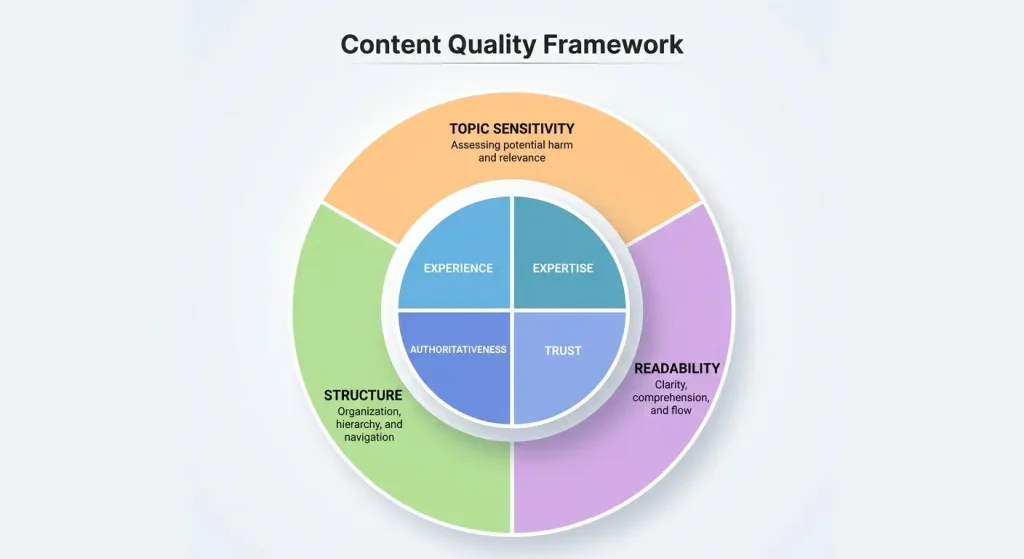
The four big signals sit at the center. Experience: does this show you’ve actually done the thing? Real examples, specific details, the kind of stuff you only know from doing it, not from skimming five other articles. Expertise: is there genuine depth here, or are you paraphrasing the first page of results? Authoritativeness: is there a believable person and site behind this? Trust, which Google itself calls the most important of the bunch: is it accurate, honest, not misleading anyone?
There’s also the question of how risky your topic is. Health stuff, money stuff, anything that could mess up someone’s life if you get it wrong (the “Your Money or Your Life” category, people call it) gets held to a much higher bar. Part of auditing is being grown-up about whether your topic needs that extra rigor.
And then the supporting layers, the ones bloggers skip. Can a normal human read this without their eyes glazing over? Is it structured so it can even be found? Anything thin or sketchy that could quietly tank trust? You add all that up and you’ve got an actual picture of whether the thing’s ready, instead of a vibe.
How to Audit Your Content for Free, Step by Step
Right, the practical bit. None of this costs money. Here’s the order I actually go in.
Step one: read it like a suspicious stranger
Sit down with the draft and pretend you’ve never met the author. You don’t trust them yet. They have to earn it. So you ask the rude questions. Who wrote this and why should I believe a word? Where’s the proof? Have they done this, or are they just confidently summarizing what’s already online? This slow, slightly hostile read is the backbone of the whole thing, and it costs you nothing but a bruised ego.
Step two: get a second opinion from a free tool
Problem with step one is you’re still you. After enough years writing, you stop seeing your own tics. This is where a free online checker earns its keep, because it doesn’t care about your feelings. Something like iloveonlinetool.com lets you drop your article in and see straight away how helpful, original, and people-first it reads, plus where it stands on the four signals, topic sensitivity, readability, and any quality risks. Runs in your browser, free. It takes the vague worry in your gut and makes it a list you can work through.
Step three: read the thing out loud
Sounds silly. Works anyway. Readability is part of trust, fair or not, because clunky writing just feels less credible. When you read aloud you hear the sentences that trip you up, the missing connective tissue, the spot where even you forgot the point. If you stumble, your reader’s already gone.
Step four: chase down your facts
Every claim, every stat, every “studies show” needs a real source behind it. Go check. Link it where it helps. Takes a few minutes, costs nothing, and it’s one of the single biggest trust moves you can make. Accuracy is the whole spine of that final T.
Four steps. A suspicious read, a free tool, a read-aloud, a fact-check. Do those and you’ve vetted your post harder than most published articles on the internet ever get vetted, which honestly says more about the internet than about you.
A Free Checklist You Can Steal Right Now
Let me make this concrete. Run any article past these. Mostly yeses? You’re in good shape. A few hesitations? You found your homework.
On experience and expertise
- Are there specific, first-hand details in here, or could anyone have written this after a quick search?
- Does it go past the surface, or stop where every other article stops?
- Is there a single insight or example that’s genuinely yours?
On authority
- Is there a named author with a bio that explains why they’d know?
- Does the site have an about page and a real way to reach someone?
- Would somebody who actually works in this field nod along, or wince?
On trust
- Are the facts right, and sourced where it matters?
- Anything exaggerated or quietly misleading? Be honest.
- Is the site secure, and do you fix mistakes when readers flag them?
On stakes and polish
- If this is a health, money, or safety topic, does it clear that higher bar?
- Is it genuinely easy to read, or a wall of grey text?
- Is every section pulling its weight, or is some of it padding to hit a word count?
The questions you flinch at are the answer. That flinch is data.
Okay, You Found Problems. Now What?
Finding gaps is the easy half. What you do next is the part that counts, and it’s where a lot of people quietly give up.
Split your fixes into fast and slow. The fast ones are almost embarrassing how quick they are. Add a bio. Drop in a source. Untangle one bad paragraph. Patch a fact you got slightly wrong. Knock those out right away, they’re cheap and they punch above their weight. The slow ones hurt more. A whole section that’s missing real expertise, or first-hand experience you simply don’t have. No quick fix there. You research properly, or you’re honest that you’re not the right person for that angle, or you cut it.
Here’s a thing I had to learn the hard way. Don’t treat the audit like a test to pass. The goal was never to make a tool say “good job.” It’s to make the post genuinely better for the person reading it. If something gets flagged as thin, the move is to make it actually useful, not to cram keywords in until a meter twitches green. Write for the human. The signals are chasing real quality, not the reverse.
The best thing audits give you, though, isn’t any single fix. It’s the pattern you start noticing across your own work. Maybe you always forget sources. Maybe you skip the specific detail. Maybe your intros ramble (mine do). Once you clock your repeat offenses you start heading them off while drafting, and the repairs shrink every month. That’s the compounding bit. Quietly powerful.
The Same Few Problems, Over and Over
I’ve audited a lot of my own stuff and plenty of other people’s. The same issues keep showing up. Knowing them ahead of time saves you the trouble of discovering them the slow way.
Number one, by a mile: nobody behind the content. No author, no bio, no hint of who’s talking or why they’d know anything. Instant trust hole, and a five-minute fix. Close behind it, the bold claim floating in space with nothing holding it up. Slap a credible source under it and suddenly “trust me” becomes “here, see for yourself.” Night and day.
Then there’s the thin, generic post. Technically about the topic. Says nothing a dozen other pages didn’t already say better. This one’s only fixable with the stuff that’s actually yours, the specific story, the real number from your own test, the honest “this part annoyed me.” Can’t fake that, can’t copy it. Readability comes up constantly too. Big undivided blocks of text. No headers. Sentences that wander off and forget where they were going.
Good news hiding in all this? These are repairable, usually fast. I almost never audit something and conclude it’s hopeless. Way more often it’s a solid post being held back by two or three little things, which is the entire reason checking before you hit publish is worth the bother.
A Few Myths Worth Killing
This corner of SEO collects bad ideas. Couple of them I hear constantly.
People think a checker hands you your exact Google score. It can’t. That number doesn’t exist to begin with, so nothing’s pulling it out of thin air. A checker estimates the qualities Google’s human evaluators look for. Useful guidance, not a report card from Mountain View.
The other one: “tool said I passed, so I’ll rank.” Wish it worked that way. Ranking depends on a pile of things, competition and relevance and how old your site is and a dozen more. A clean audit makes your content worthy of ranking. It doesn’t reserve you a spot. Still worth it, because it removes the self-inflicted wounds, and there are always self-inflicted wounds.
And the budget myth, that you need paid tools to do this properly. You don’t. An honest checklist, a free checker, a read-aloud, a fact-check. That’s a thorough audit and it cost nothing. Discipline beats your wallet here every time.
The common thread, if there is one: a checker’s a mirror, not a wand. Shows you the problem clearly. Fixing it is still on you.
Auditing the Risky Stuff More Carefully
Not every post carries the same weight, and a smart audit knows that. Write about health, money, safety, legal questions, the high-stakes stuff people lean on for real decisions, and you’ve got to crank the standards up. Get it wrong there and you can actually hurt somebody. That’s not dramatic, it’s just true.
So when you audit this kind of thing, every signal gets stricter. Accuracy stops being nice-to-have. Every claim traces to a solid, current source, and anything you’re not sure about gets verified or cut. Not guessed at. The cost of being wrong on a sensitive topic dwarfs the cost of leaving a gap.
Credibility matters more here too. For touchy subjects, readers fairly expect real qualifications or deep hands-on experience behind the words. An honest audit means asking yourself, flat out, am I actually the right person to be advising on this? And being willing to add context, soften absolute statements, or send people to a properly qualified professional when that’s the responsible call.
Last thing, transparency. Sensitive content does better when it’s upfront about its limits. Note when you’re giving general info rather than personal advice. Nudge readers toward an expert for their specific situation. Keep it updated as the facts move. None of that’s about gaming anything. It protects the reader first, and the trust follows on its own.
Making This an Actual Habit
The whole thing falls apart if you only audit once in a blue moon. Point is to bake checking into how you already work, until it stops feeling like a separate chore you keep putting off.
Easiest start: bolt a quick audit onto whatever your pre-publish routine already is. Before you hit publish, run the checklist, do the suspicious read, verify anything shaky. Adds minutes, not hours. And those minutes keep catching the stuff that would’ve quietly cost you readers.
Funny thing happens after a while. The questions creep backward into the writing itself. Once you’ve fixed the same missing-source, thin-section, no-bio problem enough times, you just stop making them. Your first drafts come out stronger without trying. The checklist turns into a safety net instead of a repair job.
That’s really the payoff of treating it as a habit and not a one-off rescue mission. Each audit teaches you something the next post inherits. The writers whose stuff consistently earns trust, in my experience, mostly aren’t the most gifted. They’re the ones who built honest checking into the routine and just kept at it.
My Honest Take
If I could hand one habit to my younger, flopping-post self, it’d be this. Audit before you publish, not after you’re staring at analytics wondering what went wrong. First few times it feels like a drag. Then it’s quick. Eventually you barely notice it, because the questions just live in your head while you write.
What I’ve come to like about a proper audit is how brutally honest it is. It peels off the optimism we all carry about our own work and shows it the way a stranger sees it. Not fun. But I don’t know a faster way to get better. Every flaw it catches is one your reader won’t, and a reader who isn’t tripping over flaws is a reader who sticks around.
One last bit of real talk. Don’t let the word “checker” fool you into thinking the tool does the work. Free or paid, it just holds the mirror up. The actual graft, adding the detail, verifying the claim, rewriting the limp section, that’s yours. Done that way, an e-e-a-t audit isn’t a chore or a trick. It’s just the gap between hoping your content’s good and actually knowing.
Pick one article. Audit it today, properly. Fix what falls out. Read it again and notice how much steadier it feels. Then do it to the next one, and the one after. That habit, more than any clever tactic I’ve ever tried, is what separates the posts that vanish from the ones that stick.
You Would Like To Know More About – E-E-A-T Signals List: 25 Factors Google’s Quality Raters Look For (and How I Check Each One)
FAQ
What is an e-e-a-t checker?
It’s any tool, process, or checklist that helps you judge how well your content shows Experience, Expertise, Authoritativeness, and Trust. Think of it as an objective editor for the quality and credibility signals you’re too close to your own writing to spot.
Can I really audit my content for free?
Yep. A solid free audit is just four things stacked together: an honest skeptical read-through, a free online checker, a read-aloud pass for flow, and a fact-check against reputable sources. No subscription needed. Mostly it takes discipline, not money.
Does a checker show my actual Google score?
No, and be wary of anything claiming it does. Google never assigns a single E-E-A-T score, so there’s nothing for a tool to reveal. A checker estimates the qualities Google’s evaluators look for and flags your gaps. Treat it as guidance.
What exactly does an audit check?
The four core signals first, then how sensitive the topic is (a health or money piece gets a higher bar), then the practical layers: readability, structure, basic SEO essentials, and anything thin or risky that could chip away at trust.
How often should I do this?
Ideally before you publish anything that matters, plus the odd sweep through older posts to keep them accurate. Building it into your normal pre-publish step beats treating it as a rare spring-clean.
What’s the most common thing audits catch?
Usually two: content with no visible author or credentials, and confident claims with nothing backing them. Both are quick fixes. Add a real bio, link a credible source, and the piece instantly reads as more trustworthy.
Do I have to be an expert to pass?
Depends on the topic. Health, finance, the high-stakes stuff, yes, real credibility counts for a lot. Plenty of other subjects lean more on genuine first-hand experience and skill. An audit just helps you show whatever real experience you’ve actually got.
Conclusion
So where does that leave you with an e-e-a-t checker? Auditing your content before it goes live is one of the cheapest, highest-return habits in blogging, and you can run the whole thing for free. An honest checklist, a free tool, a read-aloud, a quick fact-check, and you’ve vetted your post harder than most of what’s out there.
The thing to hold onto is that a checker only shows you the problem. The missing bio, the floating claim, the section that’s secretly filler. Spotting and patching those before you publish beats wondering, months later, why a perfectly good post never went anywhere.
Your move: grab your most important article and audit it today. Run the free checklist up top, drop it into a free checker like iloveonlinetool.com for that outside opinion, fix whatever surfaces, then keep doing it before everything you publish. Few extra minutes. Much better content. Easy trade.
About the Author
M – Hassan Ali — AdSense + SEO Expert Guidance Provider. Hassan works out of Pakistan and has spent years in the weeds with creators and site owners, helping them tighten up content quality and clear the standards that actually matter, with hands-on experience behind 500+ approvals. His thing is taking the messy, always-shifting guidance around content quality, E-E-A-T, and policy and boiling it down to steps a normal blogger can follow. And he tries it all on real projects first, because advice that hasn’t been tested isn’t worth much.