
A few years back I’d have told you E-E-A-T was basically vibes. Either content felt trustworthy or it didn’t, and good luck pinning down why. Then I actually sat down with how Google’s quality raters are told to evaluate pages, and the fog cleared. It’s not vibes. It’s a set of concrete, checkable things. Once you can name them, you can fix them.
That’s what this is. Not theory, not a lecture on what E-E-A-T “means.” A working list of the actual signals that go into the judgment, the ones I now run my own drafts past before anything goes live.
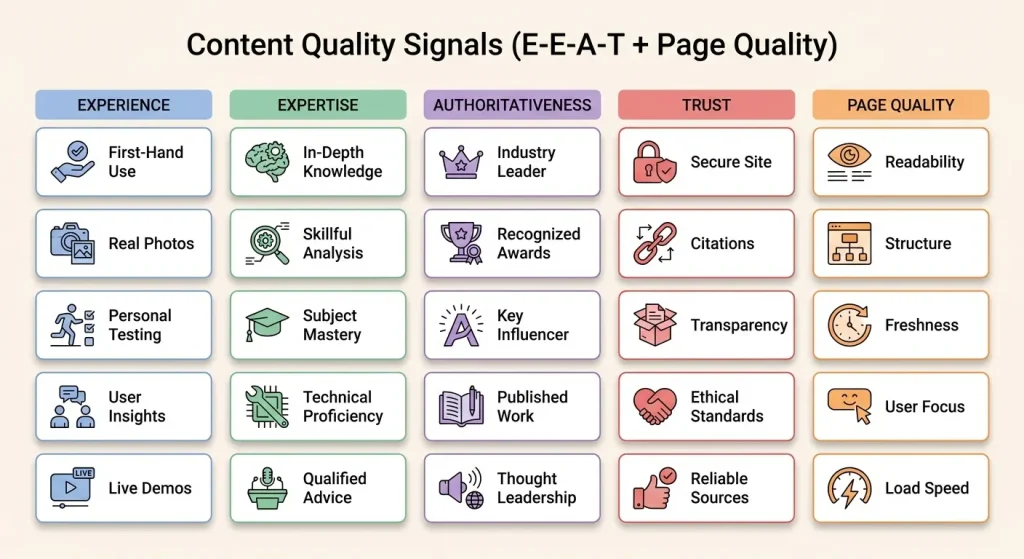
Some of these you’ll fix in a minute. Some take real effort. A couple you can’t fake no matter how clever you are, which honestly is the point of them. I’ve grouped the twenty-five into the parts of E-E-A-T they feed, so you can see how the whole thing fits together instead of memorizing a random pile.
Let’s get into it.
What an E-E-A-T Signals List Actually Is
Quick grounding first. An e-e-a-t signals list is just a breakdown of the specific factors that go into whether content looks trustworthy to Google, the same factors human quality raters are guided to weigh when they judge search results. E-E-A-T itself stands for Experience, Expertise, Authoritativeness, and Trust, with Trust sitting right at the center. The signals are the practical clues that point to each of those.
One thing to keep straight, because it confuses people endlessly. These signals aren’t direct ranking factors with little dials inside the algorithm. Google’s quality raters don’t change your ranking. They assess pages so Google can check whether its systems are surfacing genuinely good results, and that feedback shapes how the algorithms get built. So this list isn’t a set of switches to flip. It’s a description of what “trustworthy” looks like in practice, broken into pieces you can actually act on.
Why bother with the granular version? Because “make your content more trustworthy” is useless advice. You can’t do anything with it. “Add a named author, source your claims, and fix the three-year-old stats” you can do today. That’s the whole value of turning a fuzzy concept into a checklist. So here’s the list, twenty-five strong, grouped by what they feed.
Experience Signals (1–5)
This is the newer E, added to the framework in 2022, and it’s the one a lot of sites are weakest on. It asks a simple question: has the person actually done this? Not researched it. Done it. The distinction sounds small and it’s anything but. A reader can usually tell within a paragraph whether they’re hearing from someone who’s been there, and so, increasingly, can Google. These five are how that comes through on the page.
1. Genuine first-hand experience with the topic. The big one. Did the writer use the product, visit the place, live through the thing? Content that’s clearly written from doing beats content written from researching, every time.
2. Original media. Your own photos, your own screenshots, a video you actually shot. Stock images prove nothing. A slightly imperfect photo you took yourself proves you were there.
3. Specific detail you can’t get from a search. The quirk on day forty. The step the manual skips. These tiny, oddly-specific details are near-impossible to fake, which is exactly why they signal real experience so strongly. I’ve started treating them as a quality bar in my own writing. If a draft has none of these, I didn’t really write from experience, I just dressed up a summary, and it shows.
4. Evidence of the actual process. Notes on what went wrong, what you’d do differently, the part that annoyed you. Real experience is messy, and a little mess reads as honest.
5. A point of view, not a summary. Aggregated information has no perspective. Someone who’s done the thing has opinions about it. That perspective is itself a signal.
Expertise Signals (6–10)
Experience is about having done it. Expertise is about knowing it, deeply, and showing that knowledge on the page. The two overlap, but they’re not the same thing. You can have years of experience and still explain it badly, and you can be book-smart on a topic you’ve never touched. The expertise signals are about demonstrating real command of the subject, the kind that’s hard to fake because it shows up in the details.
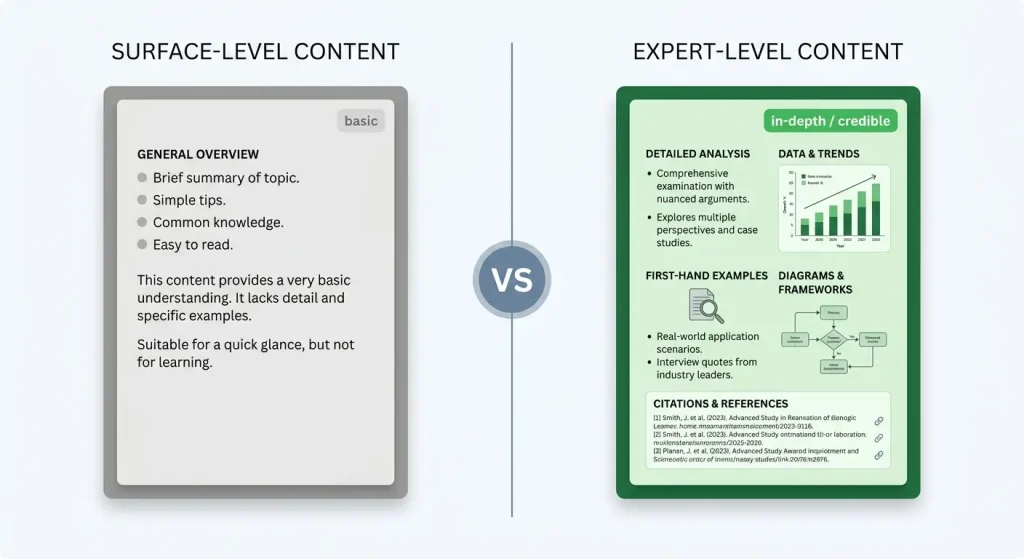
6. Depth that goes past the obvious. Surface-level content covers what everyone already knows. Expert content keeps going, into the nuance, the edge cases, the stuff only someone who really understands the topic would think to mention.
7. Relevant skill or qualification for the topic. Expertise looks different by subject. A medical page wants credentialed expertise. A recipe wants a genuinely skilled cook. Match the kind of expertise to what the topic actually demands.
8. Accuracy, down to the details. Sloppy mistakes quietly scream “this person doesn’t really know.” Getting the small facts right signals you’ve got the big ones right too.
9. Comprehensiveness. Does the page actually answer the question it raises, fully? Half-answers that send readers off to finish their research elsewhere read as thin, even when what’s there is correct. The test I use is simple: after reading this, does the person still need to open three more tabs? If yes, I left the job unfinished. Comprehensive doesn’t mean padded, though. It means complete, which is a different thing.
10. The right kind of expertise for the stakes. For everyday topics, lived experience can count as expertise. For high-stakes ones, it usually can’t on its own. Knowing which bar applies is part of the game.
Authoritativeness Signals (11–15)
Here’s where it stops being about the single page and starts being about reputation. Authority is what others say about you, not what you say about yourself. This is the slowest part of E-E-A-T to build, and the hardest to shortcut, which is exactly why it carries weight. Anyone can claim to be an authority. Being treated as one by people who’d know is a different thing entirely, and these five signals are where that shows.
11. The author’s reputation. Is this person known, or at least findable and credible, in the space? A recognized name carries weight a blank byline never will.
12. The site’s reputation. Same question, bigger. Is the website itself regarded as a go-to source on its topics, or is it a stranger on the internet? Reputation is built slowly and it shows.
13. Mentions and references from other credible sources. When respected sites and people point to you, that’s external validation Google pays attention to. You can’t really manufacture this honestly. You earn it by being worth pointing to. This is also why the shady link-buying shortcuts age so badly. They mimic the signal without the substance behind it, and systems built to spot exactly that mismatch tend to win in the end.
14. Being the recognized source for the topic. For some queries there’s an obvious authority. Becoming that for your niche, the place people land and think “okay, these folks actually know,” is the whole authoritativeness game.
15. Clear responsibility for the content. Who publishes this? Who stands behind it? A page where it’s obvious who’s accountable reads as more authoritative than one where nobody seems to own it.
Trust Signals (16–20)
Trust is the heart of the whole framework. Google’s own guidance puts it at the center, and the logic’s simple. A page can have experience, expertise, and authority, but if it isn’t trustworthy, none of that matters. Think of it this way: the other three are roads, and trust is where they’re all supposed to lead. If a page is expert and authoritative but dishonest or unsafe, the destination’s wrong and the rest is wasted. These five are the most important signals on the whole list.
16. Accuracy and honesty. The foundation. Is the content correct, and is it being straight with the reader, or quietly spinning them? Inaccuracy is the fastest way to torch trust.
17. Transparency about who’s behind the site. Real About page, working Contact, no mystery about who runs the place. Hiding reads as having something to hide.
18. A safe, secure site. HTTPS, no malware, no shady redirects, no deceptive pop-ups. Basic safety is table stakes for trust, and its absence is an instant red flag. The frustrating part is how often genuinely good content sits on a site that undermines it with this stuff. A reader who gets ambushed by a dodgy pop-up doesn’t stick around to admire your expertise. Fix the wrapper so it stops sabotaging the work.
19. Responsible handling where it counts. For sites that involve transactions or sensitive details, clear policies and reliable handling matter enormously. Even for a plain content site, the same spirit applies: treat the reader’s trust like it’s worth something.
20. An honest purpose. Was this made to genuinely help someone, or to manipulate them into a click or a sale? Content built to help reads completely differently from content built to extract, and people feel the difference fast.
Page and Site Quality Signals (21–25)
The last five are about the content and container themselves, the things that make the page genuinely good rather than just technically present. You can nail authorship and sourcing and still publish something thin, ugly, or stale. These signals catch that. They’re also some of the easiest to fix, which makes them low-hanging fruit worth grabbing early.
21. Effort and quality in the main content. Does the page look like real work went into it, or like it was churned out to fill a slot? Effort shows, and so does its absence.
22. Readability and supportive design. Structure, headers, sensible formatting, a layout that helps rather than fights the reader. Hard-to-read content feels less trustworthy even when the substance is solid.
23. Freshness where it matters. For topics that change, outdated content is a trust problem. A page giving advice that was right two years ago and wrong now actively misleads, even if nobody updated it on purpose. Not everything needs constant updating, mind you. A guide to a timeless topic can sit happily for years. The skill is knowing which of your pages are time-sensitive and keeping those current, rather than churning updates for the sake of a fresh date.
24. Extra care on YMYL topics. Anything affecting health, money, or safety, the “Your Money or Your Life” stuff, gets held to a much higher standard. Handling those topics with visible care, accuracy, and appropriate caution is itself a signal.
25. No deceptive or spammy junk. Hidden text, misleading headlines, auto-generated filler, aggressive ad layouts that bury the content. Any of it tanks trust. Their absence is quietly part of looking trustworthy.
Which of These Are Fast to Fix, and Which Aren’t
Twenty-five signals can feel paralyzing if you look at them as one giant to-do list. So here’s how I’d sort them, because not all of these cost the same.
The fast ones, the stuff you can genuinely sort this week, are mostly about making existing credibility visible and cleaning up the obvious gaps. Adding a named author and bio. Fixing your About and Contact pages. Sourcing your claims. Sorting site security. Tidying up readability and killing any spammy clutter. None of these require you to become someone new. They just stop you from hiding the trustworthiness you already have, and they’re where I’d always start.
The slow ones are a different animal. Building genuine authority, earning mentions from credible sources, becoming the recognized name for your topic, these take months and sometimes years. There’s no honest shortcut, and the dishonest ones get caught. You build them by being consistently worth referencing, which is less a task and more a way of operating.
Then there’s a middle group that’s neither instant nor endless: writing from real experience, keeping content accurate and fresh, handling YMYL topics with proper care. These are habits more than one-time fixes. You get better at them the more you do them, until they’re just how you write.
My honest suggestion is to clear the fast ones first for the quick lift and the momentum, then settle in for the slow build. Trying to do everything at once is how people burn out and quit, and E-E-A-T rewards the ones who don’t quit.
How I Actually Use This List
I don’t run all twenty-five as a formal checklist on every post. That’d be exhausting and I’d quit by week two. What I do is keep them in the back of my head while writing, then do a faster pass before publishing on the ones I know I tend to drop.
For me that’s usually the experience signals and sourcing. I’ll catch myself writing a paragraph that’s technically fine but could’ve come from anyone, and that’s my cue to either make it specific or cut it. Then I check that every claim that sounds like a fact actually has something behind it. Those two catch most of my misses.
When I want an outside read, because I’m too close to my own draft to judge it honestly, I’ll paste it into a free checker like iloveonlinetool.com and see how it scores on the signals, readability, and any quality risks before it goes live. It’s a fast gut-check on the stuff I’ve gone blind to. If you want the source behind all this, Google’s own guidance on creating helpful, reliable, people-first content is worth reading in Search Central{:rel=”nofollow”}.
My Honest Take
The thing that surprised me most, going through these properly, is how few of them are about gaming anything. Read the list again. Almost every signal is just a description of content made by a real, knowledgeable person who’s being honest. That’s it. The “SEO” of it is mostly making that realness visible on the page.
Which means the sites that panic about E-E-A-T are usually solving the wrong problem. They’re trying to bolt signals onto thin content, when the actual fix is to make the content less thin. A fake credential, a stuffed author box, a date you changed without changing anything else, these are exactly the moves the framework is designed to see through. You can’t trick your way to looking trustworthy to a system this specifically built to spot the trick.
So my honest advice after living with this list a while: don’t treat it as twenty-five hoops to jump through. Treat it as twenty-five different angles on one question. Would a smart, skeptical human trust this page and the people behind it? Get that right and you’ll hit most of these signals without consciously trying. Miss it and no amount of signal-polishing will save you.
Start with the ones you’re weakest on. For most people that’s real experience and honest sourcing. Fix those two and you’ve moved the needle more than any clever tactic will.
FAQ
What is an E-E-A-T signals list?
It’s a breakdown of the specific factors that go into whether content looks trustworthy to Google, the same things its human quality raters are guided to weigh. It turns the broad idea of E-E-A-T into concrete, checkable signals across experience, expertise, authority, and trust.
Are these signals direct Google ranking factors?
Not directly. Quality raters don’t change rankings, and there’s no single E-E-A-T score in the algorithm. Raters assess pages so Google can check and improve its systems. The signals describe what trustworthy content looks like, which is what those systems are built to reward.
Which E-E-A-T signal matters most?
Trust is the center of the framework, so the trust signals, accuracy, honesty, transparency, and safety, carry the most weight. Experience, expertise, and authority all ultimately feed into whether a page can be trusted.
How many E-E-A-T signals are there really?
There’s no official numbered list of exactly twenty-five. The real guidelines describe many overlapping signals. Grouping them into a clear set, like the twenty-five here, just makes the concept usable. Think of it as a practical map, not a fixed count.
Can a small or new site hit these signals?
Yes. Most signals, real experience, clear authorship, accuracy, honest design, don’t require being big. Authority is the slow one that takes time to build, but a new site can be genuinely trustworthy on day one and grow authority from there.
Do I need formal credentials to show expertise?
For high-stakes YMYL topics, real qualifications matter a lot. For many everyday topics, demonstrated first-hand experience and genuine skill can count as expertise. Match the kind of expertise you show to what the topic actually demands.
How do I check my content against these signals?
Keep the list in mind while writing, then do a pass before publishing on the signals you tend to drop. For an objective second opinion, a free checker that reads E-E-A-T signals, readability, and quality risks can flag gaps you’ve gone blind to.
Conclusion
So there’s your e-e-a-t signals list, twenty-five factors spanning experience, expertise, authority, trust, and overall page quality, the same kinds of things Google’s quality raters are guided to look for. The point of breaking it down this way is simple: you can’t act on “be more trustworthy,” but you can act on “add a real author and source your claims.”
The pattern running through every one of these, if you read closely, is that they reward content made by real, knowledgeable people being honest with their readers. The signals are just the visible evidence of that. Which is good news, because it means there’s no trick to learn, only a standard to actually meet.
Here’s your move: pick the three signals from this list you’re weakest on, probably something in experience or sourcing, and fix them on your most important page today. Then run that page through a free check to catch what you missed, and make that quick pass a habit before you publish anything. Twenty-five signals sounds like a lot. Met honestly, they’re really just one thing, done consistently.
About the Author
M – Hassan Ali — AdSense + SEO Expert Guidance Provider. Hassan works out of Pakistan and has spent years in the trenches with creators and site owners, helping them sharpen content quality and clear the standards that genuinely matter, with hands-on experience behind 500+ approvals. He’s spent a lot of that time turning vague guidance around E-E-A-T and content policy into plain, do-this-now steps an ordinary blogger can follow, and he runs every bit of it past real projects before he trusts it himself.