
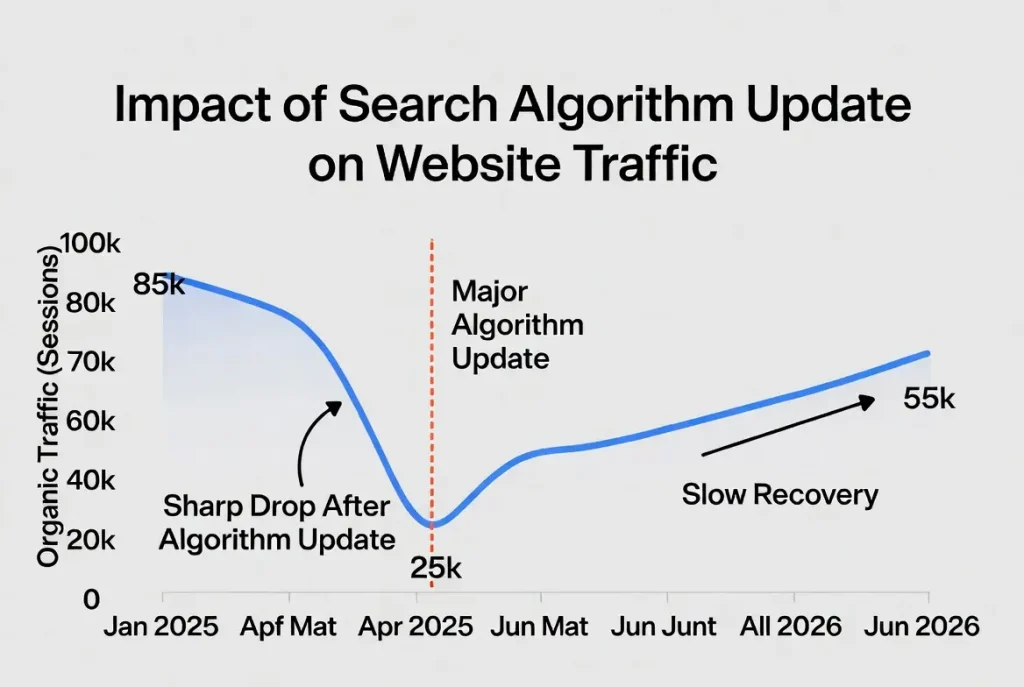
In 2022 I watched a site I’d been building for two years lose about half its traffic in a week. No manual penalty. No warning. Just a slow, sickening slide right after Google rolled out something called the helpful content update. I remember refreshing analytics like the numbers might change their mind.
They didn’t. And once the panic wore off, I actually read what Google was saying, and it stung, because it was fair. A big chunk of that site was content I’d written to rank, not to help. Thin roundups. Padded how-tos. Pages that existed because a keyword tool told me they should. The system had done exactly what it was built to do. It noticed.
That’s why I want to walk through this properly. Not as theory, but as someone who got caught on the wrong side of it and had to claw back. Because the helpful content system has changed shape since 2022, a lot of people are still working off outdated advice about it, and in 2026 the way it actually works is different from how most articles still describe it.
So here’s the honest version. What it is, how it quietly became something bigger, and what Google genuinely rewards now.
What Is the Helpful Content System? A Plain Explanation
Let’s get the helpful content system explained in plain terms before anything else. When Google launched it in August 2022, the helpful content system was a ranking mechanism designed to reward content made for people and demote content made mainly for search engines. The idea was blunt and refreshing. If you wrote to help a human, good. If you wrote to trick a ranking, bad.
What made it different at the time was that it worked site-wide. It wasn’t just judging one page. A site loaded with unhelpful, search-first content could see all of its rankings drag, even the decent pages, because the system formed a view of the whole site. That’s what caught me. My good content got dragged down by the junk I’d published around it.
Here’s the crucial update most people miss, though. The standalone “helpful content system” as a separate, named thing basically doesn’t exist anymore. In March 2024, Google folded it into its core ranking systems. So in 2026, helpfulness isn’t judged by one bolt-on classifier that runs now and then. It’s woven into the core algorithm through many signals, running all the time. The principle got stronger, not weaker. It just stopped being a separate switch you could point at.
A Quick History, Because It Explains Everything
The timeline matters here, so bear with me for a minute. It’s the fastest way to understand why old advice keeps steering people wrong.
August 2022, the system launches. Google starts rolling out periodic “helpful content updates,” and sites feel them as distinct events, the way I did. People start watching for these updates like weather, bracing for the next one.
Then March 2024. Google’s core update absorbs the helpful content system into the core ranking systems. No more separate helpful content updates as their own labeled thing. Google explicitly says it now uses a variety of signals to assess helpfulness rather than one dedicated system. This is the shift that reframes everything.
Why does it matter so much? Because if you still think of “the helpful content update” as an occasional event you prepare for, you’re planning for a world that ended in 2024. In 2026, there’s no gap between updates to hide in. Helpfulness is assessed continuously as part of how Google ranks everything. You can’t cram before the test anymore. There’s no test date. It’s always on.
And there’s a knock-on effect people underestimate. Because it’s continuous, recovery is continuous too. Under the old model, a hit site sometimes had to wait for the next helpful content update to see any lift, even after fixing things, which was maddening. Now improvements can be reflected as the core systems reassess your site over time. Slower to fall off a cliff, slower to climb back, but no more waiting months for a single dated update to notice you changed. Steady work gets noticed on a rolling basis. That’s a genuinely fairer setup, even if it removes the drama people used to plan around.
What “People-First Content” Actually Means
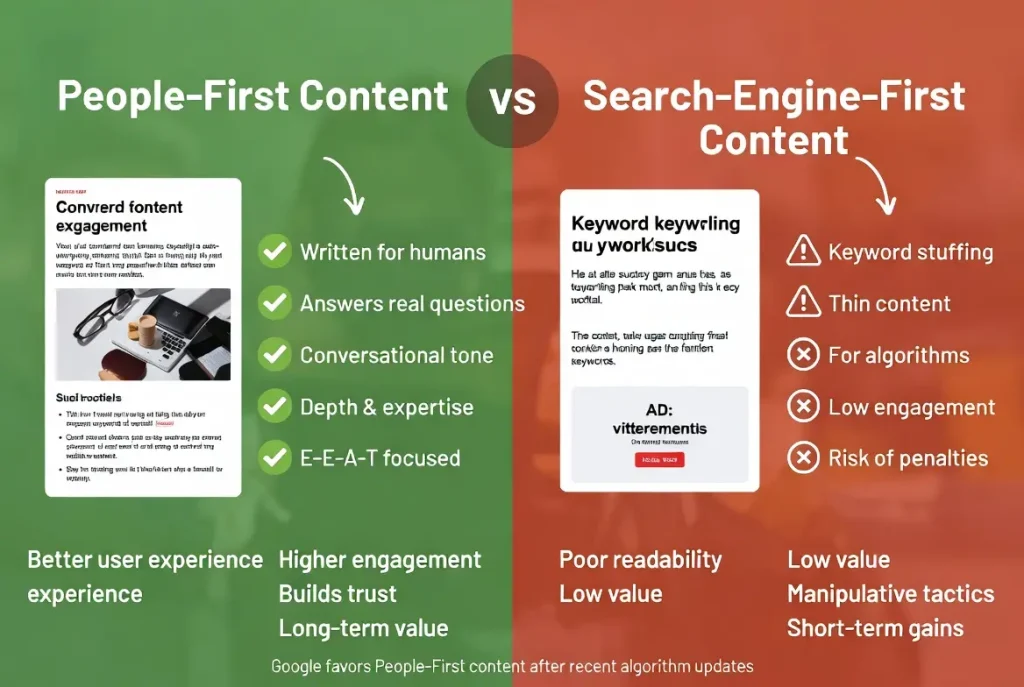
The phrase Google leans on is “people-first content,” and it’s worth pinning down, because it gets thrown around loosely. People-first doesn’t mean dumbed-down or casual. It means content created primarily to help and satisfy a real person, where any search-engine consideration comes second.
The opposite is what Google calls search-engine-first content. You know it when you see it, honestly. Content built around a keyword rather than a question. Pages that exist to catch traffic, not to answer anything. The endless “what is X” article that says nothing you didn’t already know from the title. That’s what got targeted, and that’s what still gets quietly buried.
The test Google effectively asks is whether your content would be worth making if search engines didn’t exist. Would a real person find this genuinely useful, satisfying, complete? Or does it only make sense as a bid for rankings? I find that question uncomfortably clarifying. When I look back at the pages that sank my old site, almost none of them would’ve been worth writing in a world without Google. That was the whole problem.
Worth clearing up a common misread, too. People-first doesn’t mean you ignore SEO entirely. Google is explicit that you can still do sensible SEO on top of people-first content. Keywords, structure, internal links, all fine. The order is what matters. Make something genuinely worth reading first, then optimize it so the right people can find it. The failure mode is doing it backward, starting from the keyword and reverse-engineering a page around it. That’s how you end up with something technically optimized and fundamentally empty, which is exactly what the system is tuned to catch.
What Google Actually Rewards in 2026
So, practically, what wins now? After getting this wrong and slowly getting it right, here’s what I see the system rewarding.
Content that genuinely satisfies the person who searched. Someone lands, gets what they needed, and doesn’t bounce straight back to the results to try again. That “search was satisfied” quality is gold, and it’s hard to fake because it depends on actually being useful.
First-hand experience and genuine knowledge. This is where it braids into E-E-A-T, the framework Google’s raters use to judge trustworthiness. Content clearly made by someone who’s done the thing or knows it deeply reads as helpful, because it usually is. If that framework’s new to you, it’s worth understanding what E-E-A-T actually means, since the helpful content principles and E-E-A-T are pulling in the same direction now.
Depth that matches intent. Not length for its own sake, but actually finishing the job the searcher started. Covering what they’ll wonder next. Not leaving them to open three more tabs. And a real, identifiable person or brand behind it, because anonymous mystery content is a harder sell for trust. The through-line in all of it is simple. Google rewards content that a real person would be glad they found.
What Gets Content Hit
Flip it over. It helps to know what the system reads as unhelpful, because avoiding these is half the game. This list is basically a portrait of my old site, so I say it with feeling.
Content written mainly for search engines. Made-for-ranking pages stuffed with keywords, chasing traffic with nothing real to offer. Content that summarizes what others already said without adding anything of your own. The classic “I read five articles and rewrote them” post, correct and utterly pointless.
Stuff that leaves people unsatisfied. Clickbait titles the content doesn’t deliver on. Answers that dance around the question. Thin pages that promise and don’t pay off. Also content written to a word count or a keyword quota rather than to actually cover a topic, which readers feel even if they can’t name it.
And producing lots of content on lots of topics with no real expertise or experience behind any of it, hoping volume wins. It doesn’t anymore. Because the assessment is site-wide in spirit, a pile of this kind of content can weigh down the good pages sitting next to it. That was the lesson that actually landed for me. It wasn’t one bad page. It was the company my good pages were keeping.
Google’s Own Self-Assessment Questions
One genuinely useful thing Google did was publish questions to assess your own content. I keep a version of these taped, mentally, above my desk now. Paraphrased, they ask things like:
Does your content offer original information, reporting, or analysis? Does it give a substantial, complete description of the topic? Does it provide insight beyond the obvious? Would someone reading it feel they’ve learned enough to achieve their goal, and leave feeling satisfied? Is it written by someone who clearly knows or has experienced the topic? And the gut-punch one: would you trust this content, or feel comfortable citing it?
When I ran my old content honestly through these, most of it failed. Not maliciously. It just wasn’t made to pass them, because I wasn’t thinking about the reader when I wrote it. I was thinking about the ranking. If you want a structured way to check yourself against these standards, you can work through the specific signals Google’s quality raters look for one at a time, which overlaps heavily with what the helpful content principles reward.
How This Connects to E-E-A-T
People treat the helpful content system and E-E-A-T as two separate things to worry about. They’re really two angles on the same idea. E-E-A-T, Experience, Expertise, Authoritativeness, Trust, describes the qualities that make content trustworthy. The helpful content principles describe the intent behind making it. They meet in the middle, at content genuinely made to help by someone qualified to help.
That’s not an accident. Both grew out of Google’s long push to reward real value and demote content made purely to game rankings. Understanding one makes the other click. Experience, in particular, sits at the heart of both, and if you’re fuzzy on how it differs from raw knowledge, the distinction between experience vs expertise in Google’s eyes is worth a read, because helpful content usually needs one or both.
The practical upshot: if you focus on genuinely helping readers with real experience and knowledge, you tend to satisfy both at once. You don’t optimize for the helpful content system and then separately optimize for E-E-A-T. You make honestly useful content, and both are largely handled. Google, whether by design or convergence, has made the trustworthy move and the winning move the same move.
How to Actually Make Your Content Helpful
Enough diagnosis. Here’s what I changed, and what I’d tell anyone starting from where I was.
Start with the reader’s actual goal, not the keyword. Before writing, I now ask what someone searching this genuinely wants to walk away with, and I write to deliver that fully. The keyword’s still there. It’s just no longer the boss.
Bring something only you can. Your experience, your test, your specific take, your original data or examples. If a page could’ve been written by anyone who read the same few sources, it’s not helpful, it’s redundant. This single shift, adding real first-hand substance, did more for my recovery than any technical fix.
Here’s a small habit that helped me operationalize that. Before I publish anything now, I ask one blunt question: what does this page give a reader that the top few results don’t already give them better? If I can’t answer it in a sentence, the page isn’t ready, and no amount of formatting or keyword placement will save it. Sometimes the answer is a genuine test I ran. Sometimes it’s a clearer explanation of something everyone else muddles. Sometimes it’s just honesty about a downside the other pages gloss over. But there has to be an answer. That question alone has killed more of my weak drafts than any tool, and the site’s healthier for the ones that never went live.
Cover the topic completely and be honest. Answer the follow-up questions. Don’t pad, don’t leave gaps. Cut the pages that only ever existed to rank, because on a site-wide-minded system, dead weight drags the rest. Google’s own guidance on creating helpful, reliable, people-first content is worth reading straight from the source{:rel=”nofollow”}. And before you publish, it’s worth checking whether a piece actually reads as helpful and trustworthy rather than search-first. You can run a draft through a free content audit tool to see how it scores, or if you’re triaging an existing site, an honest audit of your content helps you spot the pages pulling you down. For a full step-by-step, I’ve written up how to improve your site’s E-E-A-T separately.
Common Myths Worth Killing
A few beliefs I still hear that need to go.
“There’s a helpful content update coming, I’ll fix things before it.” No. Since 2024 it’s part of core ranking, assessed continuously. There’s no update date to beat. Waiting is just losing slowly.
“It’s a page-level thing, I’ll just fix my bad pages.” Partly. But the assessment has a site-wide character. A mass of unhelpful content can affect your whole site, so sometimes the fix is removing or seriously improving the dead weight, not just polishing your best page.
“AI content gets hit automatically.” Not quite. Google’s line is about helpfulness and quality, not how content was produced. Mass-produced, unhelpful content gets hit whether a human or a machine made it. Genuinely helpful content made with AI assistance isn’t inherently doomed. The bar is the same either way: is it actually useful, and does it show real experience and knowledge? That’s the only question that’s ever really being asked.
“Longer content always wins.” No, and this one cost me real time. I used to pad articles to hit some imagined word count, thinking depth and length were the same thing. They’re not. A tight 800-word answer that fully solves the problem can beat a bloated 3,000-word one that buries the answer under filler. Length should follow the topic, not lead it. If a question deserves a thorough treatment, go long. If it deserves a quick, clear answer, give that and stop. Padding is just a slower way of being unhelpful.
“Once you recover, you’re safe.” Not really. Because assessment is continuous, staying helpful is the job, not a one-time cleanup. I keep a rolling habit now of reviewing older pages, updating what’s gone stale, and cutting what’s stopped earning its place. The sites that hold their gains treat helpfulness as maintenance, not a rescue mission.
My Honest Take
Getting hit in 2022 was one of the better things that happened to how I work, even though it didn’t feel like it at the time. It forced me to stop treating content as a numbers game and start treating it as, well, content. Made for someone.
What I believe now, after the slow recovery, is that the helpful content system, in all its forms, is Google trying to close the gap between what ranks and what deserves to. That gap was how people like me used to win. It’s mostly gone. And honestly, good. The content that came back strongest for me was the stuff I’d have been proud to show a person, not a crawler.
So my real advice isn’t a tactic. It’s a mindset swap. Stop asking “what will rank” and start asking “what would genuinely help the person searching this, and can I actually deliver it better than what’s out there?” Answer that honestly, page by page, and you’re building the kind of site the system is designed to reward. Dodge it, and you’re just choosing a slower version of what happened to me.
FAQ
What is the helpful content system in simple terms?
It’s Google’s approach to rewarding content made to genuinely help people and demoting content made mainly to rank in search. Launched in 2022 as a standalone system, it’s since become part of Google’s core ranking, assessing helpfulness continuously through many signals.
Is the helpful content system still a separate thing in 2026?
No. In March 2024 Google folded it into its core ranking systems, so there are no longer separate “helpful content updates.” In 2026, helpfulness is judged continuously as part of the core algorithm rather than by one dedicated, periodic system.
What does people-first content mean?
Content created primarily to help and satisfy a real person, with search-engine considerations coming second. The useful test is whether your content would still be worth making if search engines didn’t exist. If it only makes sense as a bid for rankings, it’s search-engine-first.
Does the helpful content system work page by page or site-wide?
It has a strongly site-wide character. A large amount of unhelpful content can affect a whole site’s rankings, not just the weak pages. That’s why fixing it often means removing or genuinely improving dead-weight content, not only polishing your best pages.
Does Google penalize AI-generated content?
Not for being AI-made as such. Google’s focus is on helpfulness and quality. Mass-produced, unhelpful content gets hit regardless of whether a person or a tool made it, and genuinely helpful content created with AI help isn’t automatically penalized. The test is real usefulness, experience, and knowledge.
How do I recover if my site was affected?
Audit honestly against Google’s self-assessment questions, add genuine experience and depth to thin pages, remove or seriously improve content that only ever existed to rank, and commit to people-first content going forward. Recovery tends to be gradual, not instant, since assessment is continuous.
How is the helpful content system related to E-E-A-T?
They’re two angles on the same goal. E-E-A-T describes the qualities that make content trustworthy; the helpful content principles describe the intent behind creating it. Focus on genuinely helping readers with real experience and knowledge and you satisfy both at once.
Conclusion
So there’s the helpful content system explained honestly: a 2022 mechanism to reward people-first content that has, since 2024, become part of Google’s core ranking rather than a standalone system. In 2026 that means helpfulness is judged continuously, site-wide in spirit, through many signals. There’s no update to beat and no gap to hide in.
What Google rewards is genuinely simple to say and harder to live: content that satisfies the person who searched, made by someone with real experience or knowledge, that a reader is glad they found. What it buries is content made for crawlers instead of people. I learned that the expensive way, and the recovery only came once I stopped arguing with it.
Here’s your action step: pick one page and run it honestly through Google’s core question, would this still be worth publishing if search engines didn’t exist? If the answer’s no, either make it genuinely useful or let it go. Do that across your site, prioritizing the dead weight, and run your key pages through a quick helpfulness check before you publish. Build for the person, not the ranking, and the ranking increasingly takes care of itself.
About the Author
M – Hassan Ali — AdSense + SEO Expert Guidance Provider. Hassan works out of Pakistan and has spent years helping creators and site owners lift their content quality and clear the standards that genuinely matter, with hands-on experience behind 500+ approvals. A fair amount of what he teaches about helpful content and Google’s expectations came from getting it wrong on his own sites first, which is why his advice tends to skip the theory and go straight to what actually worked once he stopped writing for crawlers.