
For years I thought I was writing for people. I’d have sworn it. Then someone asked me a simple question about a post I was proud of. “Would you have written this if Google didn’t exist?” And I sat there. Because the honest answer was no. I’d started from a keyword, checked what was ranking, and built a slightly better version of that. Helpful-ish. But born from the search box, not from a person.
That question stuck with me, because it exposed something uncomfortable. Most of us who think we write for readers are actually writing for rankings and calling it reader-focused. The two can look identical from the outside. They are not the same thing underneath, and Google has gotten remarkably good at telling them apart.
So this is the piece I wish I’d read back then. Not a lecture on what people-first content is, but a practical way to tell whether you’re actually doing it, using the same honest tests I now run on my own drafts before they go live.
Because here’s the trap. Nearly everyone believes they’re doing it right. The useful skill isn’t believing it. It’s checking it. Let’s get into how.
What Is People-First Content in SEO?
Quick grounding first. People-first content SEO is the practice of creating content primarily to help and satisfy real people, then applying sensible SEO on top, rather than building content around search engines from the start. The term comes straight from Google’s own guidance on creating helpful, reliable content, and it’s become the lens Google uses to separate content worth ranking from content made only to rank.
The key word is “primarily.” People-first doesn’t mean you ignore SEO. That’s the misread that trips everyone up. You can absolutely use keywords, structure, headings, internal links, all the normal optimization. The question is one of order and intent. Did you make something genuinely worth reading and then help people find it? Or did you start with what ranks and reverse-engineer a page to catch traffic?
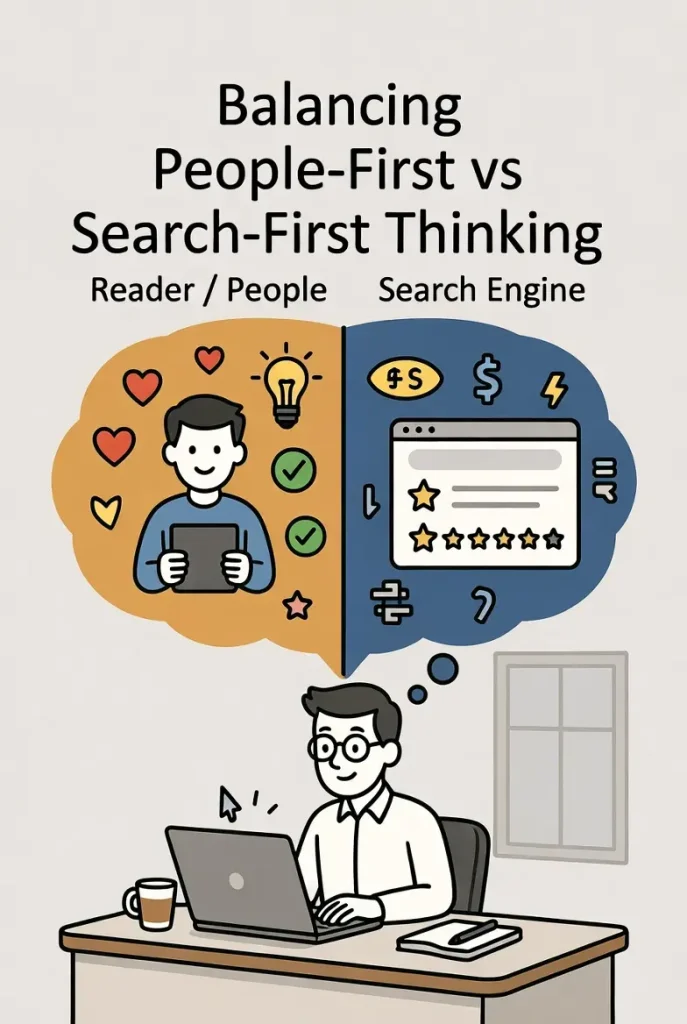
That ordering is the whole ballgame. Search-engine-first content starts with the keyword and works backward to a reader. People-first content starts with the reader and works out to the keyword. Same ingredients, opposite direction, and Google’s systems, especially since the helpful content principles became part of core ranking, are tuned to reward the second and quietly bury the first. If you want the fuller background on how that shift happened, I’ve broken down the helpful content system and what Google rewards now separately, because people-first content is really the positive half of that same story.
The Real Difference Between People-First and Search-First
Let me make the contrast concrete, because “write for people” is useless advice on its own. Here’s how the two actually differ in practice.
Search-first content begins with a keyword tool. You find a phrase with traffic, check the top results, and produce something similar but marginally better or longer. The topic is chosen because it ranks, not because you have anything to say about it. The structure mirrors whatever’s already there. The goal, if you’re honest, is to intercept a searcher, not to genuinely serve them.
People-first content begins with a person and a problem. You know something, or you’ve done something, and you want to help someone with it. The keyword research still happens, but it’s used to understand how people phrase the problem and to shape the content, not to decide whether the content is worth making at all. The difference in the finished piece is subtle but real. People-first content has a point of view, specific detail, and the sense that a human who actually cared wrote it.
A reader often can’t articulate which one they’re reading. But they feel it. Search-first content leaves that faint hollow feeling, technically-answered-but-not-really-helped. People-first content leaves you satisfied, like you got what you came for and maybe a bit more. That felt difference is exactly what Google’s trying to measure through everything from engagement patterns to E-E-A-T signals.
Here’s a tell I’ve learned to trust. Search-first content tends to answer the exact query and stop, because the query was the whole point. People-first content answers the query and then keeps going a little, into the thing you’d naturally wonder next, because the writer is actually thinking about you rather than the phrase you typed. That small overshoot, the anticipated follow-up, the caveat nobody else mentions, the “here’s what I’d watch out for,” is hard to fake convincingly. It only really shows up when you genuinely care whether the reader walks away sorted. When I audit an old page and find it stops dead the second the keyword’s been addressed, I know exactly which mode I was in when I wrote it.
Google’s “Who, How, and Why” Test
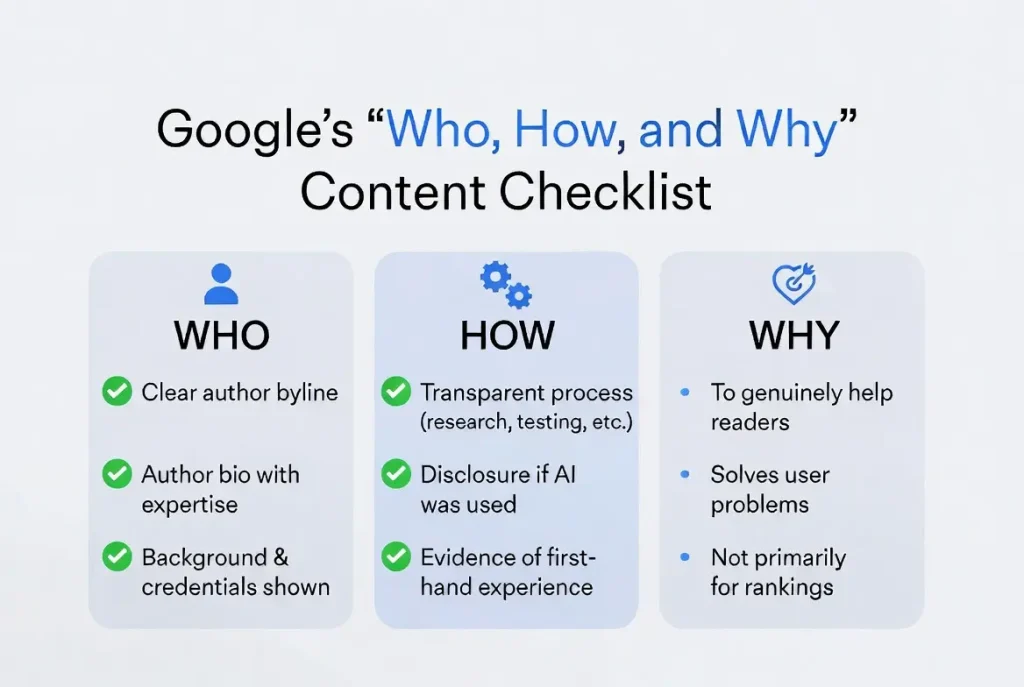
Google actually handed us a genuinely useful self-check, and I lean on it constantly. It comes down to three questions about any piece of content: who, how, and why.
Who created it. Is it clear who’s behind the content? People-first content doesn’t hide its author. It makes the person or organization, and their relevant experience, visible, because real helpful content usually has a real, identifiable human behind it.
How it was created. This matters especially with automation everywhere now. Was it made with genuine care, or churned out at scale to fill slots? Google’s guidance isn’t anti-automation as such, but it’s pointedly interested in whether content was produced mainly to game rankings through sheer volume.
Why it was created. This is the big one. Was it made primarily to help people, or primarily to attract search traffic? Google is explicit that content made mainly to rank, rather than to help, is exactly what its systems aim to demote. If you can’t honestly say the “why” is to help, that’s your answer.
I run these three on anything I’m unsure about. The “why” catches me most. It’s very easy to convince yourself a page is helpful when its actual reason for existing is a traffic opportunity you spotted.
What makes the who-how-why test so useful is that it’s hard to game honestly. You can dress up a thin page with a nice layout and a keyword in the right spots, but you can’t really fake a genuine “why” to yourself. Either you made the thing to help someone or you didn’t, and you know which. That’s why I treat it less as an SEO checklist and more as a mirror. When I’m tempted to skip it, that reluctance is usually the answer, because the pages I’m proud of never make me nervous about the why.
Signs You’re Doing People-First Content Right
Here’s the practical heart of it. How do you actually tell you’re on the right side of this? These are the green flags I look for in my own work.
You’d publish the content even if it couldn’t rank. If a page is worth making purely for the people who’d read it, that’s the clearest signal you’re people-first. It’s the test that first exposed me, and it still cuts through everything.
You’re adding something that isn’t already out there. Your own experience, a test you ran, original examples, a clearer explanation, an honest take on a downside others skip. If your page brings something the top results don’t, you’re serving readers, not just competing for a slot.
Readers leave satisfied. They get what they came for and don’t bounce straight back to the results to try another link. Your content answers the question fully and anticipates the next one. People spend real time with it because it’s actually useful.
A real person stands behind it. There’s a named author, a bio that ties them to the topic, genuine experience or knowledge on display. This is where people-first content and E-E-A-T overlap almost completely, both reward content that clearly comes from someone qualified who actually cares.
And you can explain, in one sentence, what your page gives a reader that the alternatives don’t. If that sentence comes easily, you’re probably doing it right. If you stall, that’s a flag.
One more green flag I’ve come to trust: you find yourself cutting things. When you’re genuinely writing for a reader, you notice the padding, the paragraph that repeats the last one, the section that’s there only because an outline said so, and you take it out, even though it drops your word count. Search-first writing almost never cuts, because volume feels like value when you’re writing for a crawler. People-first writing trims constantly, because every extra sentence is a small cost to a real person’s time. If your instinct while editing is to protect the reader’s attention rather than pad the page, that instinct is worth more than any checklist.
Signs You’re Doing It Wrong
Now the uncomfortable half. These are the red flags, and I recognize every one because I’ve done every one.
You chose the topic mainly because it had traffic, not because you had anything to say. The keyword came first and the content is just its costume. That’s search-first, however nicely it’s written.
Your page summarizes what others already said without adding anything of your own. If someone could get the same value from any of the other results, or from just reading the ones you read to write it, the page is redundant. Correct, and pointless.
You wrote to a word count or a keyword quota rather than to genuinely cover the topic. Padding to hit a length, stuffing a phrase a certain number of times, these are search-first tells that readers feel even when they can’t name them.
The content over-promises and under-delivers. A title that’s more compelling than what follows. An intro that dances before finally saying little. Readers land, sense the thinness, and leave. That bounce is the opposite of the satisfaction signal you want.
And the honest gut-check: you can’t say, without spinning it, that this page exists to help someone. If the real reason is traffic and you’re dressing it up as service, some part of you already knows. Google’s systems are increasingly built to know it too.
How to Actually Self-Audit Your Content
Knowing the signs is one thing. Systematically checking is another, and it’s where the real improvement happens. Here’s the process I use now.
Start with Google’s own self-assessment questions, which are freely published. Does this offer original information or analysis? Does it give a complete description of the topic? Does it provide insight beyond the obvious? Would a reader feel they learned enough and leave satisfied? Would you trust it, or feel comfortable citing it? Run your content honestly against these, and I mean honestly, the way you’d judge a stranger’s page, not your own baby.
Then go page by page across your site, not just your best work. People-first is assessed with a site-wide character, so a pile of thin, search-first pages can drag down your genuinely good ones. Sort your content into keep, improve, and cut. Be ruthless with the cut pile. Some of my biggest gains came from removing dead-weight pages that only ever existed to rank, which is counterintuitive until you’ve watched it work.
For the ones worth keeping, ask the one-sentence question of each: what does this give a reader that the top results don’t? Where you can’t answer, either add something real or let the page go. If you want an outside read, because we’re all blind to our own work, you can run drafts through a free content audit tool that scores how helpful and trustworthy a piece looks, or work through the specific signals Google’s quality raters look for one at a time. For a whole-site cleanup, an honest audit of your existing content helps you find the pages quietly holding you back.
How People-First Content Ties Into E-E-A-T and Helpful Content
People treat people-first content, the helpful content principles, and E-E-A-T as three separate things to juggle. They’re really one idea wearing three hats. E-E-A-T describes the qualities that make content trustworthy. The helpful content principles describe the intent behind creating it. People-first content is the practical instruction that follows from both: make it for the human.
They converge on the same behavior. Experience, in particular, sits at the center of all of them, and if you’re fuzzy on how lived experience differs from raw knowledge, the distinction between experience vs expertise in Google’s eyes is worth understanding, because people-first content almost always leans on one or both. Google’s own guidance on creating helpful, reliable, people-first content is worth reading straight from the source{:rel=”nofollow”}, and you’ll notice it doesn’t separate these ideas the way SEO blogs do.
The practical relief here is that you don’t optimize for three things. You do one thing well, make genuinely helpful content from real experience or knowledge for a real person, and all three are largely satisfied. If you want the structured version of building this across a site, I’ve written up how to improve your site’s E-E-A-T step by step. It’s the same muscle, worked from a slightly different angle.
Common Misunderstandings
A few beliefs that keep people stuck, worth clearing up.
“People-first means I should ignore SEO.” No. Google explicitly says you can still do SEO on people-first content. The point is sequence, not abstinence. Make it worth reading, then optimize it so the right people find it. Skipping optimization entirely just means good content nobody discovers.
“People-first means casual or dumbed-down.” Also no. People-first is about intent, not tone. A dense, technical, expert piece can be deeply people-first if it’s genuinely made to help the person who needs that depth. Writing for people means writing for your actual reader, whoever that is, at whatever level they need.
“If it’s well-written, it’s automatically people-first.” Not necessarily. Search-first content can be beautifully written. Polish isn’t the test. Intent and value are. A gorgeous page that only exists to catch traffic and adds nothing new is still search-first, just prettier.
And the one I hear most: “I already write for people.” Maybe. But the only way to know is to actually run the tests, not to assume. Almost everyone believes this about themselves, which is exactly why checking beats believing.
There’s also a quieter misunderstanding worth naming: treating people-first as a one-time conversion rather than an ongoing standard. People will overhaul a site once, feel good, and drift back into old habits the moment a tempting keyword shows up. Intent isn’t a switch you flip and forget. It’s a discipline you keep, page after page. The sites that stay on the right side of this aren’t the ones that had a big cleanup. They’re the ones that kept asking the honest question every single time they published, long after the initial fix.
My Honest Take
The shift from search-first to people-first wasn’t a technique for me. It was a change in where I started. I used to open a keyword tool. Now I open with a question: who am I actually trying to help here, and what do I genuinely have to offer them? Sounds soft. It changed my results more than any tactic ever did.
What I’ve come to believe is that the whole people-first push is Google slowly closing the gap between content that ranks and content that deserves to. For a long time that gap was where a lot of us lived, producing search-first content that worked well enough. That gap is closing, and honestly, I’m glad. The work I’m proud of now is the work that does well, which wasn’t always true.
So my real advice isn’t a checklist item. It’s a habit of honesty. Every time you’re about to publish, ask the question that once caught me flat: would I make this if search engines didn’t exist? If yes, you’re on the right side of this. If no, you already know what needs to change. The tests in this piece just help you stop lying to yourself about which one it is.
FAQ
What is people-first content in SEO?
It’s content created primarily to help and satisfy real people, with SEO applied on top rather than driving the whole thing. The term comes from Google’s guidance and describes content made to genuinely serve readers instead of content built mainly to rank in search.
Does people-first content mean I should stop doing SEO?
No. Google is explicit that you can still do SEO on people-first content. The difference is order and intent: create something genuinely worth reading first, then optimize it so the right people can find it. Skipping SEO just means helpful content nobody discovers.
How do I know if my content is people-first?
Run Google’s who, how, and why test and ask the core question: would you publish this if search engines didn’t exist? If your content has a clear author, adds something original, satisfies the reader fully, and exists mainly to help rather than to rank, you’re on the right side.
What’s the difference between people-first and search-engine-first content?
Search-first content starts with a keyword and works backward to a reader, chosen because it ranks. People-first content starts with a person and a problem, using keywords to shape and surface it. Same ingredients, opposite direction and intent.
Can people-first content still rank well?
Yes, increasingly it’s the content that ranks best. Since the helpful content principles became part of Google’s core ranking, content made genuinely for people tends to be rewarded, while content made mainly to rank is more likely to be demoted.
Is well-written content automatically people-first?
No. Search-first content can be polished and well-written. The test is intent and value, not style. A beautifully written page that only exists to catch traffic and adds nothing new is still search-engine-first, just nicer to look at.
How does people-first content relate to E-E-A-T?
They’re closely linked. E-E-A-T describes the qualities that make content trustworthy; people-first describes the intent to make it for readers. Focus on genuinely helping people with real experience and knowledge, and you satisfy both at once.
Conclusion
So here’s people-first content SEO, honestly: content made primarily to help real people, with SEO layered on top, rather than content built around search engines from the start. The signs you’re doing it right are clear once you look, a real author, something original to offer, readers who leave satisfied, and content you’d publish even if it couldn’t rank. The signs you’re doing it wrong are just as clear, and usually just as uncomfortable to admit.
The difference between the two is rarely visible on the surface. It lives in where you started and why the page exists. Google has gotten good at reading that, which means the old game of dressing up search-first content as reader-focused is running out of room.
Here’s your action step: take one page you’re proud of and ask the honest question, would I have made this if search engines didn’t exist? Then run it through Google’s who, how, and why. Where it falls short, add something real or let it go, and make that check a habit before you publish anything. Do it consistently and you stop guessing whether you’re people-first. You’ll know, because you’ll have actually checked.
About the Author
M – Hassan Ali — AdSense + SEO Expert Guidance Provider. Hassan is based in Pakistan and has spent years helping creators and site owners raise their content quality and clear the standards that genuinely matter, with hands-on experience behind 500+ approvals. Much of what he shares about people-first content started as habits he had to unlearn on his own sites, which is why his advice leans practical and a little confessional rather than theoretical.