
The scariest SEO decision I ever made was deleting almost half my blog. Not editing. Deleting. Roughly two hundred posts, gone, most of them things I’d sweated over at some point. My hands were actually a little shaky doing it, because everything in me said more pages equals more traffic, and here I was throwing pages away on purpose.
Three months later the site was healthier than it had been in two years. The pages I kept climbed. The overall traffic recovered and then passed where it had been. Turns out those two hundred posts weren’t helping. They were quietly dragging everything else down, and I’d been feeding the problem for years without knowing it.
That problem has a name: thin content. And if your blog has been stuck, or slid after an update, there’s a decent chance it’s part of yours too.
So let’s do this properly. What thin content actually is, how to find it hiding on your blog, and, the part that matters most, how to fix it without wrecking what’s working. This is the process I used, mistakes and all.
What Is Thin Content in SEO?
Let’s define it before we hunt it. In SEO, thin content is any page that offers little or no real value to the person reading it. That’s the whole idea, and it’s the foundation of any thin content SEO fix: the problem isn’t length, it’s value. A page can be long and still be thin, and it can be short and genuinely useful. Google cares about whether the page actually helps someone, not how many words it took.
The term goes back a long way. Google’s old Panda update in 2011 first went after low-value, thin content at scale, and the same principle now lives inside Google’s core ranking through the helpful content approach. If you want the background on how that judgment became continuous rather than a periodic update, I’ve unpacked the helpful content system and what Google rewards now separately. Thin content is essentially the negative image of everything that system rewards.
Here’s the mindset shift that finally helped me. Stop thinking of thin content as “short pages” and start thinking of it as “pages that waste a reader’s click.” A 300-word answer that fully solves a problem isn’t thin. A 2,000-word article that pads and repeats and never really says anything is. Once you judge by value delivered rather than word count, you start seeing your thin pages clearly, sometimes uncomfortably so.
What Actually Counts as Thin Content
Thin content wears a few different costumes. Recognizing the types makes them far easier to spot on your own site. Here are the ones I see most.
Pages with almost no substance. The classic thin page, a few generic sentences that don’t really answer anything. Often published to “cover a keyword” and left to rot.
Content that only rehashes what’s already out there. You read a few articles and rewrote them, adding nothing of your own. Technically original wording, functionally a copy. This was most of my deleted pile, honestly.
Mass-produced pages at scale. Dozens or hundreds of near-identical pages spun up to catch long-tail traffic, each one hollow. Location pages that are the same paragraph with the city name swapped. That kind of thing.
Low-value affiliate or doorway-style pages. Pages that exist mainly to funnel clicks somewhere, with thin surrounding content that doesn’t stand on its own. Google’s been explicit about these for years.
And auto-generated filler. Content churned out with no genuine care or oversight, made to fill slots rather than help. Note that this is about quality and value, not the tool used, a point worth keeping straight. The common thread across all of them is the same: the page doesn’t earn the reader’s time.
One type that catches bloggers off guard is what I’d call accidental thin content, pages that were fine once and quietly went thin. A post that answered a question well in 2021 but is now outdated and half-wrong. A tutorial for a tool that has since changed completely. These weren’t thin when you published them, which is exactly why they slip past. Time turned them thin. That’s worth remembering when you audit, because you’ll be tempted to only check the pages you already suspect. Some of your worst offenders are old posts you were once proud of, now silently misleading the handful of people who still land on them.
Why Thin Content Hurts More Than You Think
Here’s the part I underestimated for years. I figured a thin page was, at worst, neutral. It might not rank, but how could it hurt? Wrong. Thin content actively damages your site, and in a way that’s easy to miss.
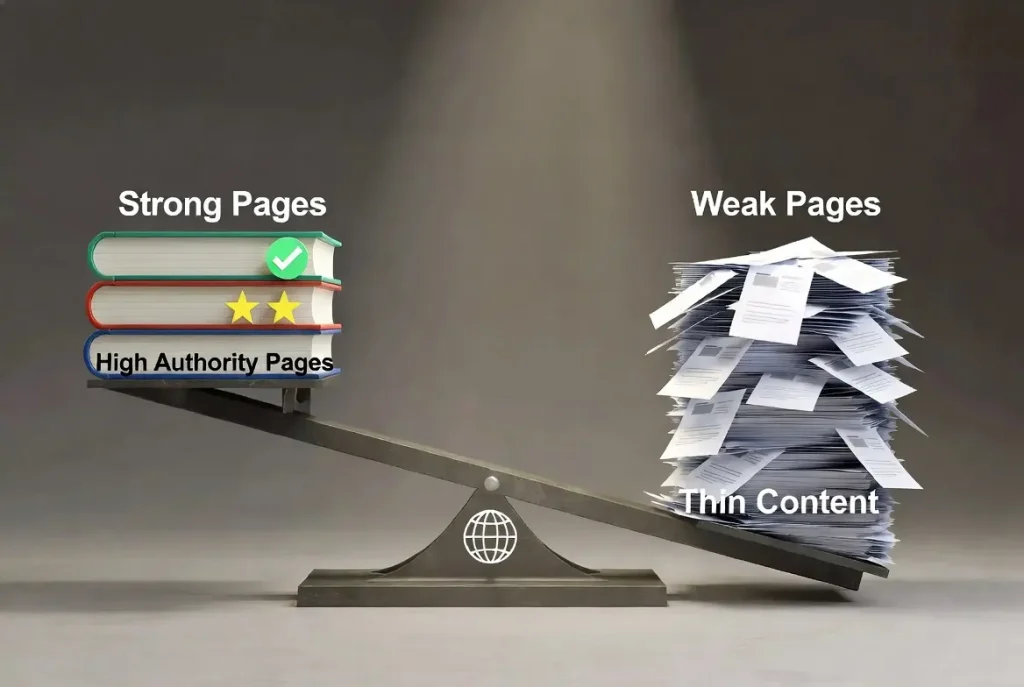
The big one is the site-wide effect. Google’s helpful content approach assesses your site with a site-wide character, not just page by page. So a large amount of thin, low-value content can weigh down your whole domain, including your genuinely good pages. That’s exactly what happened to me. My best posts were being held back by the company they kept. When I cut the dead weight, the good pages were suddenly free to rise.
Thin content also burns crawl attention and dilutes your site’s focus. It sends readers a bad first impression when they land on a hollow page and bounce, and those bounces are a signal. It can spread your topical authority thin across too many weak pages instead of concentrating it in strong ones. None of these is dramatic on its own. Together, across hundreds of pages, they add up to a site that underperforms what its best content deserves. That’s the quiet tax thin content charges, and most bloggers pay it without ever seeing the bill.
How to Find Thin Content on Your Blog
You can’t fix what you can’t see, so finding it comes first. Here’s the audit process I use, and it’s less painful than deleting blind.
Start with your analytics. Pull a list of all your pages and look at traffic over the last several months. Pages getting essentially no organic traffic over a long stretch are your first suspects. Not automatically thin, but worth a hard look. Add engagement to the picture: pages where the few visitors who arrive bounce fast or barely stay are waving a flag.
Then actually read the suspects, honestly. This is the step people skip, and it’s the important one. Open each page and ask the blunt question: does this genuinely help someone, and does it give a reader anything they couldn’t get better elsewhere? If you stall, it’s probably thin. I judge my own pages the way I’d judge a stranger’s, which is the only way to be honest about it.
A trick that helps me stay honest: imagine you clicked this page from a search result, having never seen it before, with a real problem you needed solved. Would you feel helped, or would you hit back and try the next link? That imagined bounce is brutally clarifying. It strips away the affection you have for a page because you wrote it, and leaves only the question that actually matters to Google, did the reader get what they came for. Most of the pages I ended up deleting failed this instantly once I pictured myself as a stranger who didn’t care how hard I’d worked on them.
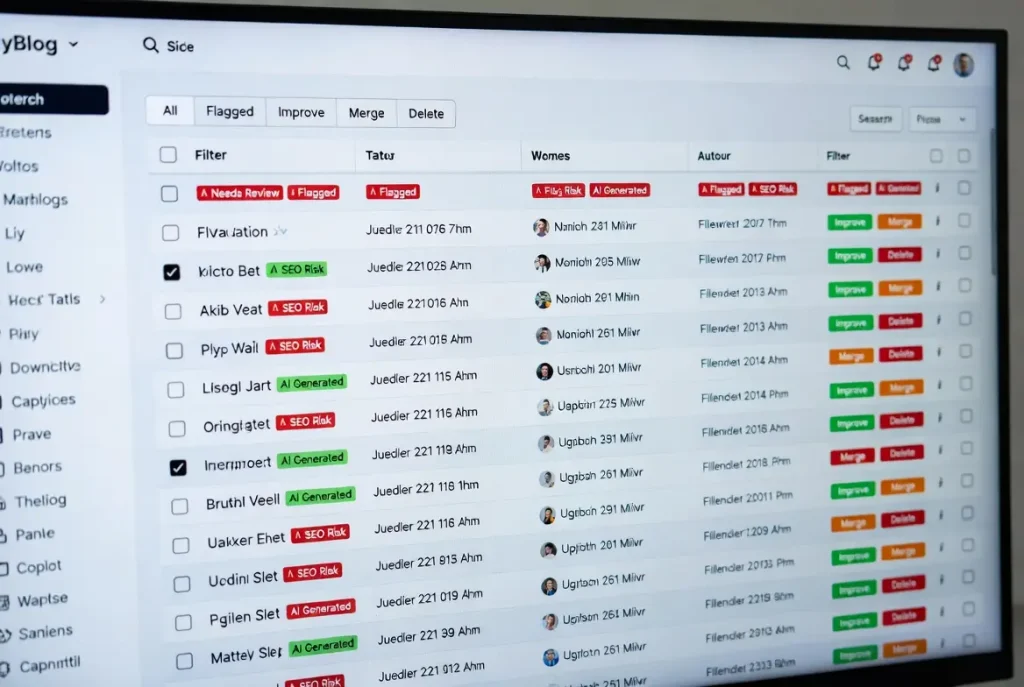
Look for the patterns from the last section. Rehashed content, near-duplicate pages, hollow keyword-bait, orphaned posts nobody links to. Group your pages into three buckets as you go: improve, merge, or remove. If you want an outside read on whether a page is actually helpful and trustworthy, you can run it through a free content audit tool or work through the specific signals Google’s quality raters look for to pin down what’s missing. For a whole-site sweep, an honest audit of your existing content helps surface the pages quietly holding you back. Word count can be one input here, but never the verdict. Judge by value, always.
How to Fix Thin Content: The Three Real Options
Here’s the core of your thin content SEO fix. Once you’ve found a thin page, you have exactly three honest moves. Improve it, merge it, or remove it. Which one depends on the page.
Improve it. For pages on a topic that genuinely matters to your blog, the best fix is usually to make them good. Add real depth, first-hand experience, original examples, the specifics that were missing. Answer the question fully and anticipate the follow-ups. Bring the page up to the standard of your best work. Most of my “kept” pile got this treatment, and many of those posts became some of my strongest performers once they actually deserved to be.
Merge it. Often you’ll have several thin pages circling the same topic, each too weak to stand. Combine them into one comprehensive, genuinely useful page, then redirect the old URLs to it. This consolidates your value and your ranking signals into a single strong page instead of splitting them across weak ones. Merging saved a lot of content I’d otherwise have deleted, and the combined pages usually beat any of the originals.
Remove it. Some pages can’t be saved and shouldn’t be. Content that’s irrelevant to your focus, hopelessly outdated, or that would take more effort to fix than it’s worth. Delete these, or noindex them if they serve a non-search purpose. This is the scary one, but it’s often the highest-impact. Cutting genuine dead weight lifts the site-wide burden on everything else. When you remove pages, redirect any with useful links or lingering traffic to a relevant live page rather than leaving dead ends.
How do you decide which of the three a page gets? I use a rough rule. If the topic matters to my blog and I can genuinely make the page good, I improve it. If several weak pages are fighting over one topic, I merge them. If the page is off-topic, obsolete, or I’d be starting from scratch anyway, I remove it. When I’m torn between improve and remove, the deciding question is whether I actually have something real to add. If I don’t, no amount of editing will save it, and removal is the honest call. That single distinction, do I have real value to add or not, resolved most of my hard cases faster than any traffic metric did.
Thin Content vs Short Content: Don’t Confuse Them
This distinction is important enough to slow down on, because getting it wrong sends people in exactly the wrong direction. Thin is not the same as short. I cannot say this enough.
Short content can be excellent. If someone searches a simple question and you answer it clearly in 400 words, that’s a great page. Padding it to 2,000 words to “fix thinness” would make it worse, not better, burying the answer under filler a reader has to wade through. That’s the padding trap, and it’s search-first thinking dressed up as a fix.
Thin content is about missing value, not missing length. The fix for thin content is more value, which sometimes means more words and sometimes means better, tighter ones. A short page that fully serves its purpose needs nothing. A long page that says little needs a rethink, or a merge, or the axe. When you evaluate your pages, resist the reflex to reach for a word counter. Reach for the honest question instead: does this help the reader who lands here? Length follows value. It never leads it.
How to Stop Creating Thin Content Going Forward
Fixing your existing thin content is only half the job. If you keep producing it, you’re bailing a leaky boat. So here’s how I stopped adding to the pile.
The biggest change was where I start. I used to start from keywords, which is how thin content is born, you chase a phrase whether or not you have anything real to say about it. Now I start from something I can genuinely help with. This is the whole idea behind people-first content, and it’s the single best prevention there is. If you’ve got nothing real to add to a topic, that’s a sign not to publish, not a keyword to force.
Before publishing anything now, I ask one blunt question: what does this page give a reader that the top results don’t already give them better? If I can’t answer it in a sentence, the page isn’t ready, no matter how many words it has. That single filter has stopped more thin pages than any audit, because it kills them before they’re born.
And I’ve made peace with publishing less. Fewer, genuinely valuable posts beat a flood of thin ones every time, especially under a site-wide assessment. Google’s own guidance on creating helpful, reliable, people-first content says as much straight from the source{:rel=”nofollow”}. Quality over quantity sounds like a cliche until you’ve watched two hundred thin posts drag down your best work. Then it just sounds like the truth.
Common Mistakes When Fixing Thin Content
A few traps I fell into, so you don’t have to.
Padding thin pages with filler to hit a word count. This treats the symptom you imagined instead of the real problem. A padded page is still thin, now with extra reading. Add value, not volume.
Deleting too aggressively without checking. Before you remove a page, check whether it has backlinks, lingering traffic, or a real purpose. Some “low-traffic” pages serve a genuine need or hold valuable links. Improve or merge those rather than nuking them, and always redirect when you do remove something worthwhile.
Fixing a few pages and stopping. Thin content clean-up isn’t a one-off. New thin content creeps in, old fixes go stale. The sites that stay healthy treat this as ongoing maintenance, a periodic content review, not a single rescue mission.
Expecting overnight results. This one wrecks people’s nerve. After you cut and improve, the recovery is usually gradual, not a next-day spike, because Google reassesses your site over time rather than all at once. I nearly panicked in the first few weeks after deleting those two hundred posts, convinced I’d made a catastrophic mistake, because nothing moved. The lift came weeks later and kept building for months. If you do the work and don’t see instant change, that’s normal. Hold your nerve and let the reassessment catch up. Reversing a good cleanup because it didn’t pay off in a week is how people snatch defeat from the jaws of a recovery.
And ignoring the site-wide picture. People polish their best page and wonder why nothing improves, while a hundred thin pages sit untouched dragging everything down. The gains often come from the cutting and merging, not the polishing. If you’re serious about lifting the whole site, pair this with a structured push on how to improve your site’s E-E-A-T, because thin-content cleanup and trust-building are two halves of the same job.
My Honest Take
Deleting half my blog taught me something I resisted for years: in content, more is not better. Better is better. I’d built a site on the assumption that every page was an asset, and it turned out a lot of them were liabilities I’d mistaken for assets because they existed.
The reframe that stuck is thinking of my site as a whole, not a pile of individual posts. Every thin page is a small drag on everything around it. Every genuinely strong page lifts the neighborhood. Once I saw it that way, cutting the weak pages stopped feeling like loss and started feeling like clearing room for the good stuff to breathe.
So my real advice, if your blog feels stuck: be honest about which pages actually deserve to exist. Not which ones you’re attached to, or which ones took effort, or which ones might someday get a stray visit. Which ones genuinely help a reader. Improve the ones you can, merge the ones that belong together, and have the nerve to cut the rest. It’s uncomfortable. It also works, and I’ve got the recovered traffic to prove it.
FAQ
What is thin content in SEO?
Thin content is any page that offers little or no genuine value to readers. It’s defined by lack of value, not lack of length. Examples include hollow keyword-bait pages, rehashed content, mass-produced near-duplicates, and low-value affiliate or auto-generated filler.
Does thin content hurt my whole site or just those pages?
Both, really. Thin pages underperform themselves, but because Google assesses sites with a site-wide character, a large amount of thin content can drag down your whole domain, including your good pages. Removing or fixing it often lifts the rest of the site.
How do I find thin content on my blog?
Start with analytics to spot pages with little traffic or engagement over several months, then read those pages honestly and ask whether they genuinely help anyone. Look for rehashed, hollow, or near-duplicate pages, and sort everything into improve, merge, or remove.
How do I fix thin content?
You have three honest options: improve the page with real depth and value, merge several weak pages on the same topic into one strong page and redirect the old URLs, or remove pages that can’t be saved and redirect any with links or traffic. Choose based on the page.
Is short content the same as thin content?
No. Short content can be excellent if it fully answers what the reader needs. Thin content lacks value regardless of length. Never pad a good short page to fix “thinness,” and never assume a long page is safe just because it’s long.
Should I delete or noindex thin content?
Delete pages that are irrelevant or beyond saving, and redirect any worthwhile links or traffic to a relevant live page. Noindex pages that serve a real non-search purpose but shouldn’t rank. Improve or merge anything on a topic that genuinely matters to your blog.
How do I stop creating thin content?
Start from what you can genuinely help with rather than from keywords, and before publishing, ask what your page gives a reader that the top results don’t. Publish fewer, more valuable posts. If you can’t add real value to a topic, that’s a reason not to publish it.
Conclusion
So there’s your thin content SEO fix, start to finish: thin content is any page that wastes a reader’s click, it’s judged by value rather than length, and it can quietly drag down your entire site through Google’s site-wide assessment. You find it by pairing analytics with honest reading, and you fix it with one of three moves, improve, merge, or remove.
The hardest part isn’t the technique. It’s the honesty, and the nerve to cut pages you’re attached to. But a lean site of genuinely valuable pages beats a bloated one full of dead weight, and it isn’t close. I learned that by deleting half my blog and watching the rest finally take off.
Here’s your action step: pull up your analytics, find your five worst-performing pages, and read them honestly. For each, decide, improve, merge, or remove, and act on at least one today. Then make a content review a recurring habit rather than a one-time panic. Clear the dead weight, keep raising the bar, and give your best work the room it needs to actually perform.
About the Author
M – Hassan Ali — AdSense + SEO Expert Guidance Provider. Hassan is based in Pakistan and has spent years helping creators and site owners lift their content quality and clear the standards that genuinely matter, with hands-on experience behind 500+ approvals. A lot of what he teaches about thin content came from the expensive lesson of building it himself first, then clawing back by learning what actually deserves to stay on a site, which is why his advice tends to favor honesty over comfort.