
I remember refreshing my analytics on a September morning in 2023 and feeling my stomach drop. A site I’d been growing for years had lost a big chunk of its traffic overnight. No warning, no manual penalty notice, nothing. Just a graph that fell off a ledge. It took me days to piece together what had happened, and the answer was three words I’d been half-ignoring: helpful content update.
If you’ve landed here, there’s a fair chance you’ve felt some version of that drop, or you’re trying to understand a thing that keeps getting mentioned and keeps changing shape. The confusing part is that the Google helpful content update isn’t really one event. It’s a series of them, and then, oddly, it became something that doesn’t exist as a separate update at all anymore.
That evolution matters, because most advice online is describing a version of this that’s already out of date. So let me walk you through what actually changed, step by step, and what it genuinely means for your site in 2026, not what it meant three years ago.
This is the recap I wish someone had handed me the morning my traffic vanished.
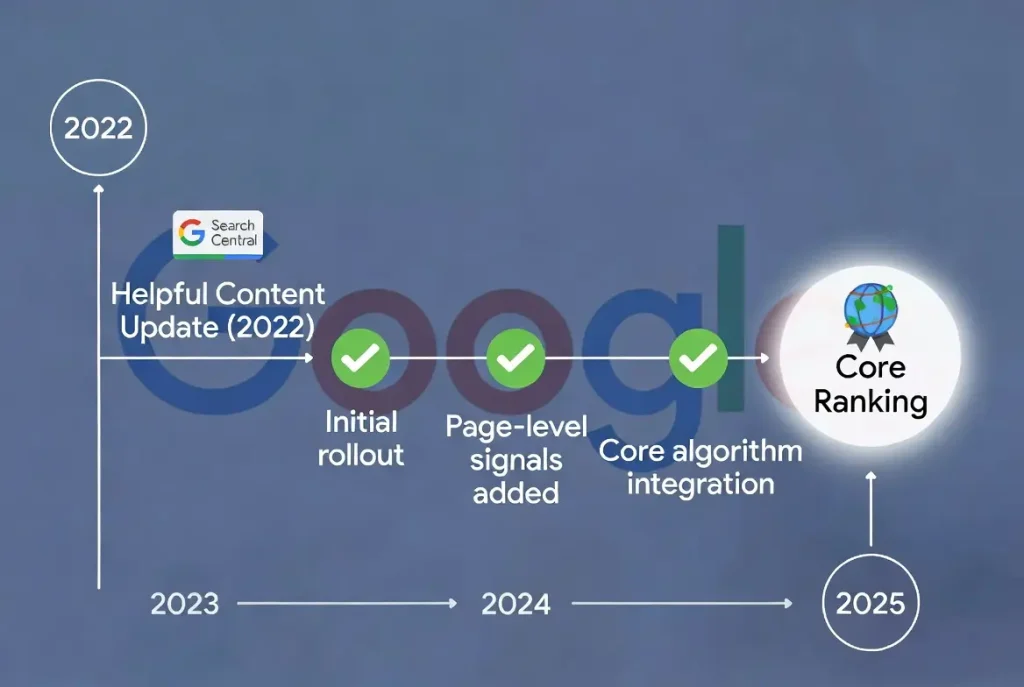
What Is the Google Helpful Content Update?
Start with the basics. The Google helpful content update was a series of ranking changes, first launched in 2022, designed to reward content made to genuinely help people and to demote content made mainly to rank in search. Google introduced it through a site-wide classifier, a system that assessed whether a site carried a lot of unhelpful, search-engine-first content, and could dampen the visibility of sites that did.
The important word there is “was.” Because as of the March 2024 core update, the helpful content update no longer exists as a separate, named thing. Google folded its logic into the core ranking systems, so helpfulness is now judged continuously by multiple core signals rather than by one standalone system that rolled out on specific dates. I’ve written a fuller breakdown of the helpful content system explained in depth if you want the mechanics, but the short version is this: what started as a distinct update became part of the furniture.
That single shift is the source of most of the confusion out there. People still talk about “the next helpful content update” as if it’s an event to prepare for. It isn’t, not anymore. Understanding when and how that changed is the key to reading everything else correctly, so let’s go through the timeline properly.
The Timeline: What Changed and When
The clearest way to understand this is chronologically, because each step changed what site owners actually needed to do. Here’s how it unfolded, with the caveat that exact mechanics were never fully public and my framing is based on what Google announced and what the wider SEO community observed.
August 2022, the launch. Google rolled out the first Helpful Content Update, introducing the site-wide classifier. The message was blunt: content made primarily for search engines rather than people could see its whole site affected. Sites started feeling these as distinct, datable events, the way I eventually would.
December 2022, the second one. Google ran another helpful content update, refining and reinforcing the system. Around this same period, Google expanded its quality framework by adding the extra “E” for Experience to E-A-T, making it E-E-A-T, which tied closely into the same helpfulness push.
September 2023, the big one. This is the update that hit me and a lot of others hard. The September 2023 helpful content update caused significant volatility, and many site owners reported large, painful traffic losses. It was widely seen as one of the more aggressive rounds, and it’s the moment a lot of people first took this seriously, usually because they had to.
March 2024, the disappearing act. In the March 2024 core update, Google integrated the helpful content system into its core ranking systems. It stopped running separate, labeled helpful content updates. Officially, there’s no more standalone “Helpful Content Update”, helpfulness became one of many signals assessed continuously as part of core ranking. That’s where we still are heading through 2026.
It’s worth pausing on why that last step matters so much, because it’s easy to skim past as a naming technicality. It isn’t. When something is a separate system, you can think of it as a door you either pass through or don’t on a given date. When it’s woven into core ranking, it’s more like air quality, a constant condition your whole site sits inside. Google essentially decided that helpfulness was too important to be a periodic side-check and made it part of the baseline judgment applied to everything. That reframing is the reason so much older advice reads as slightly wrong now. It’s describing a door that no longer exists.
The Big Change: From an Update You Wait For to a System That’s Always On
Of everything on that timeline, the March 2024 shift is the one that changes how you should actually behave. It’s worth sitting with, because it flips the old strategy on its head.
Under the old model, a helpful content update was an event. It rolled out on a date, hit sites, and then you lived with the result until the next one. This created a specific, painful problem: if you got hit and then fixed your content, you often had to wait for the next update to run before you’d see any recovery. People waited months, watching a flat line, wondering if their fixes had worked. I was one of them.
Now that helpfulness is baked into continuous core ranking, that waiting game is largely gone. Assessment happens on a rolling basis. There’s no update date to beat and no single event to recover from. The upside is real: improvements can be picked up as Google reassesses your site over time, rather than being frozen until the next dated update. The flip side is there’s nowhere to hide either. You can’t cram before a known test, because there’s no test date. It’s always on.
So the practical takeaway is a mindset change. Stop thinking in terms of surviving the next update and start thinking in terms of staying continuously helpful. That’s not a slogan, it’s the literal mechanics of how this works now.
![A before-and-after comparison of periodic updates versus continuous core assessment]](https://iloveonlinetool.com/wp-content/uploads/2026/07/hcK0M-1024x687.webp)
Who Got Hit, and Why
Understanding who these updates targeted helps you figure out whether you’re at risk, and I say this as someone who was squarely in the crosshairs. The pattern was fairly consistent across rounds.
Sites with large amounts of content made mainly to rank rather than help took the hardest hits. Think mass-produced articles, thin rehashes of what was already ranking, pages built around keywords rather than genuine expertise or experience. The September 2023 round in particular seemed to hammer sites that had scaled content production without scaling actual value.
The site-wide character mattered enormously. Because the classifier assessed sites as a whole, you didn’t need every page to be bad. A large enough proportion of unhelpful content could weigh down the whole domain, including your genuinely good pages. That’s exactly what got me. My best work was being dragged down by the hundreds of thin, search-first pages surrounding it. If your site has a lot of that kind of dead weight, it’s worth learning how to find and fix thin content before it costs you the way it cost me.
And sites lacking clear experience, expertise, or trust signals were more exposed. Content that read like it could’ve been written by anyone, with no visible author, no first-hand insight, nothing that couldn’t be found in the ten articles it was quietly rephrasing. That absence of genuine E-E-A-T was a common thread among the sites that suffered.
What surprised me, and stung a bit, was that plenty of hit sites weren’t obviously spammy. Some were run by people who genuinely cared and worked hard. The problem wasn’t effort, it was direction. They’d poured real work into content that was fundamentally built for search engines rather than readers, often because that’s simply how everyone taught you to do SEO for a decade. So if you got caught up in this and you don’t think of yourself as a spammer, you’re probably right. A lot of us were just doing diligently what the old playbook told us to, and the playbook changed underneath us. That’s not an excuse to stay there, but it might take some of the shame out of it, which matters when you’re staring at a graph that fell off a cliff.
What It Actually Means for You Now
So strip away the history. What does all this mean for you, practically, in 2026? A few things, and they’re more reassuring than the horror stories suggest.
First, there’s no update to wait for or fear. Since helpfulness is part of continuous core ranking, your job isn’t to brace for the next helpful content update. It’s to keep your content genuinely helpful, all the time. This is actually freeing once it clicks. You stop playing defense against dates and start just doing the work.
Second, the fix is the same as the goal. Whether you’re recovering from a past hit or protecting yourself from a future slide, the answer is identical: make content for people, not search engines. That means starting from what you can genuinely help with, adding real experience and depth, and cutting or improving the hollow pages. The whole approach is what I’ve laid out under people-first content, and it’s not a trick, it’s the actual thing Google is trying to reward.
Third, recovery is possible but gradual. Because assessment is continuous, a site that genuinely improves can recover over time as Google reassesses it. It’s rarely an overnight bounce. When I finally recovered mine, it came weeks and months after the work, not days. If you fix things and don’t see instant movement, that’s normal. Hold your nerve.
And fourth, something people rarely say out loud: this is genuinely good news if you’re willing to do the work, and bad news mainly if you were relying on shortcuts. A world where helpful content wins is a world that rewards the people actually trying to help, which, if you’re reading a 3,000-word guide on recovering from an algorithm change, is probably you. The sites that can’t survive this are the ones that never had anything real to offer. If you do, the shift is on your side, even when it doesn’t feel that way from inside a traffic drop.
Google’s own guidance on creating helpful, reliable, people-first content is worth reading straight from the source{:rel=”nofollow”}, and it’s aged better than most third-party takes precisely because it describes principles rather than a single update.
How to Recover If You Were Hit
If your site took a hit somewhere along this timeline and hasn’t come back, here’s the honest recovery path, drawn from clawing my own site back.
Start with an unflinching content audit. Go through your pages and sort them honestly into improve, merge, or remove. Judge by value delivered, not by effort or attachment. This is the hardest part emotionally and the most important practically. If you want an outside read, running pages through a free content audit tool or checking them against the signals Google’s quality raters look for helps you see what you’re too close to see yourself. For a whole-site view, an honest audit of your content surfaces the pages dragging you down.
Then act on the audit. Improve the pages worth saving with real depth and first-hand substance. Merge weak pages competing over one topic into single strong ones. Remove or noindex genuine dead weight, redirecting anything with links or traffic. Because the assessment is site-wide, clearing the unhelpful mass often does more than polishing your best page ever could.
After that, keep going and wait. Recovery under continuous core ranking is a rolling process, not a switch. Keep publishing genuinely helpful content, keep improving old work, and give Google time to reassess. If you want a structured plan for the rebuild, I’ve laid out how to improve your site’s E-E-A-T step by step, which pairs naturally with a helpful-content recovery because they’re really the same work from different angles.
One thing I’d add from experience: resist the urge to make drastic changes every few days out of panic. When my traffic first dropped, I wanted to do something big every morning, and that impulse nearly made things worse. Rushed, thrashing changes muddy the signal and make it harder to tell what’s actually working. A calmer approach beat a frantic one for me. Make a solid batch of genuine improvements, document what you changed, then give it real time before judging the result. Recovery rewards steady, deliberate work far more than it rewards frantic activity, however much the falling graph makes you want to grab every lever at once.
Common Misconceptions
A few beliefs that keep tripping people up, worth clearing away.
“There’s a new helpful content update coming, I’ll fix things before it.” No. Since March 2024 it’s part of core ranking, assessed continuously. There’s no dated update to beat, and waiting is just losing slowly.
“The helpful content update penalized my site.” Not in the manual-penalty sense. It was a ranking adjustment, not a penalty you’ll see in Search Console’s manual actions. That distinction matters, because recovery works differently, you improve and get reassessed rather than filing a reconsideration request.
“It only targets AI content.” No. Google’s line is about helpfulness and value, not how content was produced. Mass-produced unhelpful content gets hit whether a human or a machine made it, and genuinely helpful content isn’t doomed just because a tool helped make it. The question is always whether it actually helps.
“I just need to fix my worst page.” Partly. But the assessment has a site-wide character, so a pile of thin pages can weigh you down even if your best page is great. Sometimes the fix is clearing the dead weight, not polishing the star.
“If I wasn’t hit, I don’t need to worry about it.” Risky thinking. Because helpfulness is now continuous and baked into core ranking, a site that’s fine today can slide later as standards rise and competitors improve. Not getting hit in a past round isn’t a permanent pass. It just means you were above the bar then. The bar keeps moving, quietly, all the time, so the safe posture is to keep improving rather than to assume you’re settled.
“Recovery means everything goes back exactly how it was.” Often not. Search changes around you while you’re recovering, competitors shift, the landscape moves. A genuine recovery usually means your good content earns its rightful place again, not that a specific old traffic number returns to the decimal. I had to make peace with a recovery that looked different from the peak I was chasing, and honestly, it was healthier for it.
My Honest Take
Getting hit in September 2023 was miserable, and I won’t pretend otherwise. But looking back, it forced a reckoning I’d been avoiding. I’d built a site on volume, on the quiet assumption that more pages meant more traffic, and the helpful content update called that bluff in the bluntest way possible.
What I’ve come around to is that this whole saga, the launches, the brutal 2023 round, the eventual folding into core ranking, is Google slowly and clumsily closing the gap between content that ranks and content that deserves to. For years that gap was where a lot of us made our living. It’s closing, and the businesses built on the old gap are the ones still panicking about “the next update.” There isn’t one. There’s just the standard now, applied all the time.
So if I could go back and tell my stomach-dropping self one thing that morning, it’d be this: stop waiting for the algorithm to change back. It won’t. The work that recovers you is the same work that would’ve protected you, make things genuinely worth reading, for actual people, and keep doing it. Unglamorous, slow, and the only thing that’s ever actually worked for me.
FAQ
What is the Google helpful content update?
It was a series of ranking changes, first launched in August 2022, designed to reward content made to help people and demote content made mainly to rank. It used a site-wide classifier. As of March 2024 it’s no longer a separate update, its logic is part of Google’s core ranking systems.
Is there still a helpful content update in 2026?
Not as a standalone, dated update. Since the March 2024 core update, helpfulness is assessed continuously as part of core ranking through multiple signals. There’s no separate helpful content update to wait for or prepare around anymore.
When were the main helpful content updates?
The first launched in August 2022, followed by another in December 2022, and a notably impactful one in September 2023. In March 2024, Google integrated the system into core ranking and stopped running separate helpful content updates.
Was the September 2023 update really that bad?
Many site owners reported significant, painful traffic losses around the September 2023 helpful content update, and it caused notable volatility. Experiences varied, but it was widely regarded as one of the more aggressive rounds before the system moved into core ranking.
Is a helpful content hit a penalty?
Not in the manual-penalty sense. It’s a ranking adjustment, not a manual action you’d see and appeal in Search Console. Recovery works by genuinely improving your content and being reassessed over time, rather than by filing a reconsideration request.
How do I recover from a helpful content hit?
Audit your content honestly, then improve the pages worth saving, merge weak overlapping ones, and remove or noindex genuine dead weight. Because assessment is site-wide and continuous, clearing unhelpful content and staying helpful lets Google reassess and recover you gradually over time.
Does the helpful content update target AI content?
No, not specifically. Google focuses on helpfulness and value, not how content was made. Unhelpful mass-produced content gets hit regardless of whether a human or machine created it, and genuinely helpful content isn’t penalized simply for using AI assistance.
Conclusion
So here’s the Google helpful content update in plain terms: it began in August 2022 as a site-wide system to reward helpful content and demote search-first content, ran as a series of updates, hit hard in September 2023, and then, in March 2024, dissolved into Google’s core ranking systems where it now operates continuously. The single most important thing to understand is that it’s no longer an event you prepare for. It’s a standard applied all the time.
That changes the game from defense to habit. There’s no update to fear and no date to beat, just the ongoing work of being genuinely useful to real people, which is the only thing that reliably holds up.
Here’s your action step: stop asking when the next helpful content update is coming and start asking whether your content actually deserves to rank right now. Pick your weakest pages, judge them honestly, and improve, merge, or remove them this week. Do that consistently, and you’re no longer bracing for an algorithm. You’re just running a site worth ranking, which is the whole point Google was clumsily driving at all along.
About the Author
M – Hassan Ali — AdSense + SEO Expert Guidance Provider. Hassan is based in Pakistan and has spent years helping creators and site owners lift their content quality and clear the standards that genuinely matter, with hands-on experience behind 500+ approvals. He learned the helpful content update the hard way, watching a site he’d built lose big and slowly clawing it back, which is why his advice here leans on lived recovery rather than tidy theory.