
Here’s a confession that still stings a little. For years, I could look at one of my own articles and honestly believe I’d written it for readers, when I’d actually written it for a crawler. The two look almost identical on the page. That’s what makes this so hard to catch. You’re not being lazy or cynical. You genuinely think you’re helping people, while every real decision you made was quietly aimed at Google.
I only learned to spot the difference after a bad traffic drop forced me to reread hundreds of my own posts with cold eyes. And once I could see the warning signs, I saw them everywhere in my archive. The same tells, over and over, in content I’d been proud of.
So this is a diagnostic, not a lecture. Nine specific warning signs that an article was written for search engines rather than people, all of which I’ve committed personally. Read them against your own work, honestly. If a few feel uncomfortably familiar, good. That discomfort is the first useful thing that has to happen.
Because here’s the thing Google has quietly made true: content written for search engines increasingly doesn’t rank in search engines. The irony is total, and it’s the whole reason this matters.

What Is Content Written for Search Engines?
Let’s define the thing before we diagnose it. Content written for search engines is content whose real purpose is to rank and attract traffic, rather than to genuinely help the person reading it. Google calls the opposite people-first content, and it has spent years building systems to reward the second and quietly bury the first.
The tricky part is that search-first content isn’t always bad writing. It can be grammatically clean, well-formatted, even long and detailed. The problem lives underneath, in why it exists and how it was built. It started from a keyword instead of a person. It was shaped to please an algorithm instead of to solve a problem. And readers feel that hollowness even when they can’t name it, which is exactly what Google’s systems are increasingly good at measuring too. If you want the positive version of all this, I’ve written separately about people-first content and how to tell you’re doing it right. This piece is the shadow side: how to catch yourself doing the opposite.
Why does spotting this matter so much in 2026? Because since the helpful content principles became part of Google’s core ranking, being search-first isn’t just a missed opportunity, it’s an active liability. So let’s go through the nine tells, one at a time.
1. You Started With a Keyword, Not a Reader
This is the original sin, the one that produces most of the others. You opened a keyword tool, found a phrase with traffic, and decided to write about it, not because you had anything to say, but because it had search volume. The topic chose you, through its numbers.
Here’s why it’s a problem. When the keyword comes first, everything downstream serves the keyword instead of the reader. You’re not answering a person’s question, you’re occupying a search result. Readers can feel that the article has no real reason to exist beyond catching them.
The fix is a reversal of order. Start from something you can genuinely help with, then use keyword research to understand how people phrase it and to shape the piece. Keywords aren’t evil. They’re just a terrible place to start. When I flipped this single habit, the quality of everything else followed almost automatically.
There’s a simple test for this one. Look at your topic and ask whether you’d have anything worth saying about it if it had no search traffic at all. If the honest answer is no, that you only picked it because the numbers looked good, you’ve caught yourself starting from the keyword. The topics where you’d happily write even to an audience of one are the ones worth building on. The rest are just traffic bets wearing article costumes.
2. It Reads Like It Was Written to Hit a Word Count
You can feel padding. The paragraph that restates the last one in slightly different words. The throat-clearing intro that takes four sentences to say nothing. The section that exists purely because an outline said the article should be “comprehensive.” Search-first content pads, because word count feels like value when you’re writing for a crawler rather than a person.
The problem is that padding actively costs the reader. Every filler sentence is a small tax on their time and attention, and they pay it by skimming, then bouncing. That bounce is a signal, and it’s the opposite of the satisfaction you actually want.
The fix is brutal editing. Cut anything that doesn’t earn its place, even when it drops your word count. Real people-first writing trims constantly, because it respects the reader’s time. Length should follow the topic, never lead it. A tight answer beats a bloated one every single time. This ties directly into recognizing thin content and how to fix it, because padding is just thinness wearing a longer coat.
3. The Same Keyword Appears Over and Over, Awkwardly
Read a suspect article aloud. If you keep bumping into the exact same phrase, jammed into sentences where a normal human would use a pronoun or a synonym, that’s keyword stuffing, and it’s one of the oldest search-first tells there is. “Looking for the best budget laptop? Our budget laptop guide covers every budget laptop so you can choose a budget laptop.” Nobody talks like that. Nobody wants to read like that either.
The problem is twofold. It reads terribly, which pushes people away, and it signals to Google that the content is optimized for a phrase rather than written for a person. Modern search doesn’t need you to repeat a term to understand what a page is about, so the repetition buys you nothing and costs you readability.
The fix is to write naturally and trust that. Use the phrase where it genuinely fits, use variations and related terms elsewhere, and otherwise just write like you’re explaining something to a person who asked. If a keyword feels forced, it is. Take it out. A useful habit here is reading the draft out loud, because your ear catches what your eye forgives. Any sentence that makes you wince when spoken is almost always a spot where you bent language to fit a keyword instead of bending the keyword to fit the language.
4. It Rehashes the Top Results and Adds Nothing New
Here’s the one that made up most of my deleted archive. You searched the keyword, read the top few articles, and wrote a slightly reworded, slightly longer version of what they already said. Original wording, zero original substance. A confident summary of other people’s summaries.
Why it’s a problem: if a reader could get the exact same value from any of the other results, or from the articles you read to write yours, your page is redundant. It adds another identical option to a crowded shelf. Google is actively trying to reduce that kind of sameness, not reward it.
The fix is to bring something only you can. Your own experience, a test you ran, original data or examples, a genuinely clearer explanation, an honest take on a downside everyone else skips. Before publishing, I now ask one blunt question: what does this give a reader that the top results don’t already give them better? If I can’t answer it in a sentence, it’s rehash, and rehash is search-first by definition.
5. There’s No First-Hand Experience Anywhere in It
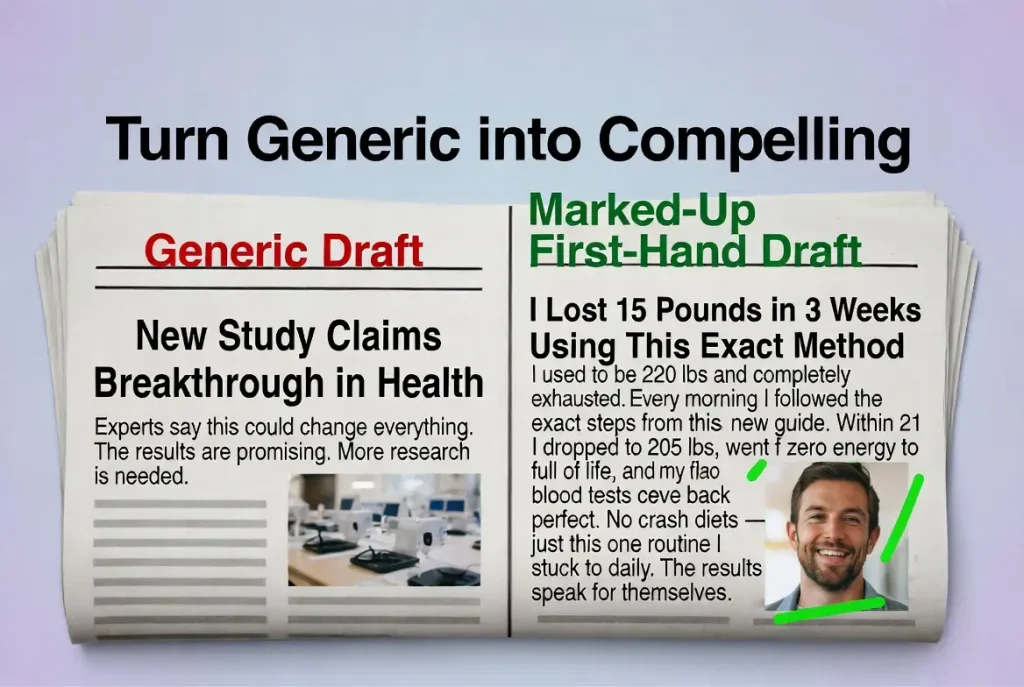
Read the article and ask: could this have been written by someone who has never actually done the thing they’re writing about? If the answer is yes, that’s a warning sign. Search-first content is almost always experience-free, because it was assembled from other sources rather than lived.
This matters more than it used to. Google added Experience to its quality framework for a reason, and first-hand experience is exactly what’s missing from search-first content and impossible to fake convincingly. It’s the difference between “here are the ten tips every article lists” and “here’s what actually happened when I tried these, and which ones were useless.” If you’re fuzzy on how lived experience differs from textbook knowledge, the distinction between experience versus expertise is worth understanding, because search-first content usually has neither.
The fix is to write about things you’ve actually done, or to go do them first. Add the specifics only someone who was there would know. The friction you hit, the thing that surprised you, the mistake you made. That texture is what separates a page a human made from a page a crawler prompted.
6. The Structure Is Optimized for Google, Not for Reading
This one’s sneaky because it hides inside “best practices.” Headings crammed with keyword variations no reader cares about. A tacked-on FAQ that just repeats the article in question form to grab a search feature. Sub-sections that exist to target related keywords rather than because the reader needs them. The skeleton itself is built for the algorithm.
The problem is that structure built for machines usually reads worse for humans. A forced FAQ full of stilted questions, headings that sound like search queries instead of natural signposts, an article contorted around a keyword map. Readers sense the artificiality, and the whole thing feels engineered rather than written.
The fix is to structure around the reader’s actual journey through the topic. What would they want to know first, then next? Use headings that genuinely describe what follows, in plain language. Include an FAQ only if people really do ask those questions. Optimization on top of a reader-first structure is fine. Optimization instead of it is the problem.
7. It Answers the Query and Then Just Stops
Here’s a subtle tell I’ve come to trust. Search-first content tends to answer the exact query and stop dead, because the query was the whole point. The moment the target phrase is technically addressed, the article’s job is done and it wraps up, often abruptly. There’s no sense of a writer thinking about what you’d naturally wonder next.
Why it’s a problem: real helpfulness overshoots a little. When someone genuinely cares whether you walk away sorted, they anticipate the follow-up question, mention the caveat nobody else does, add the “here’s what I’d watch out for.” Search-first content never does this, because the writer’s attention was on the keyword, not on you. That missing overshoot is felt as a faint incompleteness, even when the literal question got answered.
The fix is to keep going one useful step past the obvious answer. After you’ve solved the stated problem, ask what this person would realistically run into next, and address that too. Not padding, genuine anticipation. It’s one of the clearest signals that a human who cared wrote the thing.
8. Nobody Is Really Behind It
Look for the author. Search-first content is often authorless, or credited to a vague byline with no real expertise or experience attached. No bio that ties a person to the topic, no sense of who is talking or why you should trust them. The content floats free of any accountable human.
The problem is that trust is central to how Google assesses quality, and trust needs a source. Content with no visible, credible person behind it is harder to trust and reads as more disposable, which is exactly the impression search-first content gives off. This is where these warning signs overlap heavily with a weak E-E-A-T profile, and specifically the signals Google’s quality raters look for when judging whether a page is trustworthy.
The fix is to put a real person behind your content. A named author, a genuine bio connecting them to the subject, visible experience or credentials where relevant. Not for show, but because real helpful content genuinely tends to come from real, identifiable people who know their stuff.
9. Deep Down, It Exists to Rank, Not to Help
This is the master sign, the one all the others are really symptoms of. Ask yourself the honest question about any article: would I have made this if search engines didn’t exist? If the truthful answer is no, if the page exists purely because of a traffic opportunity, then whatever else is true, it’s content written for search engines.
Why it matters: this is essentially the exact question Google’s helpful content approach asks about your content, its “why.” Content created primarily to attract search traffic rather than to help people is precisely what the system aims to demote. So this isn’t just a philosophical gut-check, it maps directly onto what actually determines whether you rank. The whole story of the helpful content update and what it means for you is Google getting better and better at reading this “why.”
The fix isn’t a tactic, it’s honesty. Before you write, know who you’re actually helping and what you genuinely have to offer them. If the only reason a page exists is that a keyword looked juicy, that’s your answer. Either find a real reason to make it, or don’t make it.
How to Shift From Search-First to People-First
Spotting the signs is step one. Actually changing how you work is where it pays off, so here’s the shift in practical terms, drawn from doing it myself.
Change where you start. This is ninety percent of it. Begin with a reader and a problem you can genuinely help with, then bring keywords in to shape and surface the piece, not to justify its existence. Get the starting point right and most of the nine signs never appear in the first place.
Build a pre-publish gut-check. Mine is a single question asked of every draft: what does this give a reader that the top results don’t, and would I make it if search didn’t exist? If either answer is weak, the piece isn’t ready. That filter alone kills most search-first content before it’s born. Google’s own guidance on creating helpful, reliable, people-first content is worth reading straight from the source{:rel=”nofollow”}, and it reads like a checklist against these exact warning signs.
And audit what you’ve already published, because your archive is full of past-you’s search-first work. Reread old posts with cold eyes, run them through a free content audit tool or an honest audit of your existing content for an outside read, and improve, merge, or cut the ones that trip these warning signs. Fixing the back catalog often matters as much as getting new pieces right.
My Honest Take
The uncomfortable truth I had to sit with is that I was writing for search engines while sincerely believing I was writing for people. That’s the real trap here. It’s not that search-first writers are cynical. Most of us genuinely think we’re being helpful, which is exactly why these warning signs are worth having, they catch what sincerity alone misses.
What changed everything was rereading my own work as a stranger, someone who didn’t care how hard I’d worked and just wanted their problem solved. From that seat, the search-first tells were glaring. The padding, the rehash, the abrupt endings, the total absence of me anywhere in the writing. I’d been optimizing for a machine and calling it service.
So my real advice isn’t to memorize nine signs. It’s to build the habit of reading your own work coldly, from the reader’s chair, and asking whether you’d have made it in a world without Google. Do that honestly and often, and you slowly stop being able to write for search engines even when you try, because you can feel it happening. That instinct is worth more than any checklist, including this one.
FAQ
What does “content written for search engines” mean?
It means content whose real purpose is to rank and attract traffic rather than to genuinely help the reader. Google calls the opposite people-first content. Search-first content often starts from a keyword and is shaped to please an algorithm instead of solving a real person’s problem.
Is writing for search engines always bad?
The problem isn’t doing SEO, it’s letting search engines drive everything at the expense of readers. Sensible optimization on top of genuinely helpful content is fine. Content built primarily for search engines, with the reader an afterthought, is what Google increasingly demotes.
How can I tell if my content is search-first?
Check it against the warning signs: it started from a keyword, reads padded, repeats phrases awkwardly, rehashes other articles, has no first-hand experience, is structured for Google, stops the moment the query is answered, has no real author, and ultimately exists to rank rather than help.
Does keyword use make content search-first?
No. Keywords themselves are fine and useful. The issue is order and intent. Using keywords to shape and surface genuinely helpful content is people-first. Building content around keywords with the reader as an afterthought, or stuffing phrases unnaturally, is search-first.
Why does search-first content struggle to rank now?
Because the helpful content principles became part of Google’s core ranking, helpfulness is assessed continuously. Content made mainly to rank rather than help is exactly what those systems aim to demote, so search-first writing has shifted from a missed opportunity to an active liability.
Can search-first content be well-written?
Yes, and that’s what makes it hard to catch. Search-first content can be clean, formatted, and long. The problem lives underneath, in why it exists and how it was built. Polish isn’t the test. Genuine value and intent to help are.
How do I fix content written for search engines?
Start from a reader and a problem instead of a keyword, cut padding, write naturally, add first-hand experience, structure around the reader, and put a real author behind it. Then audit old posts and improve, merge, or remove the ones that trip the warning signs.
Conclusion
So there are your nine warning signs that an article was written for search engines: it started from a keyword, it’s padded to a word count, it repeats phrases awkwardly, it rehashes without adding anything, it has no first-hand experience, it’s structured for Google, it stops the moment the query is answered, nobody credible is behind it, and underneath it all it exists to rank rather than help. Any one is a yellow flag. Several together is a diagnosis.
The deeper point is that these signs all trace back to a single question, the “why” behind the page. Get that right, write to genuinely help a real person, and the warning signs mostly can’t take root. Get it wrong, and no amount of optimization saves you, especially now that Google assesses helpfulness continuously.
Here’s your action step: take one article you’re proud of and read it as a cold stranger, scoring it honestly against all nine signs. Wherever it trips, fix that one thing, and make the reading-as-a-stranger habit part of how you publish from now on. Do it consistently and you’ll stop writing for search engines almost without trying, which, ironically, is the surest way to actually rank in them.
About the Author
M – Hassan Ali — AdSense + SEO Expert Guidance Provider. Hassan is based in Pakistan and has spent years helping creators and site owners raise their content quality and clear the standards that genuinely matter, with hands-on experience behind 500+ approvals. He can spot search-first writing quickly for an unflattering reason, he produced a great deal of it himself before learning to catch the signs, which is why this guide reads more like a confession than a critique.