
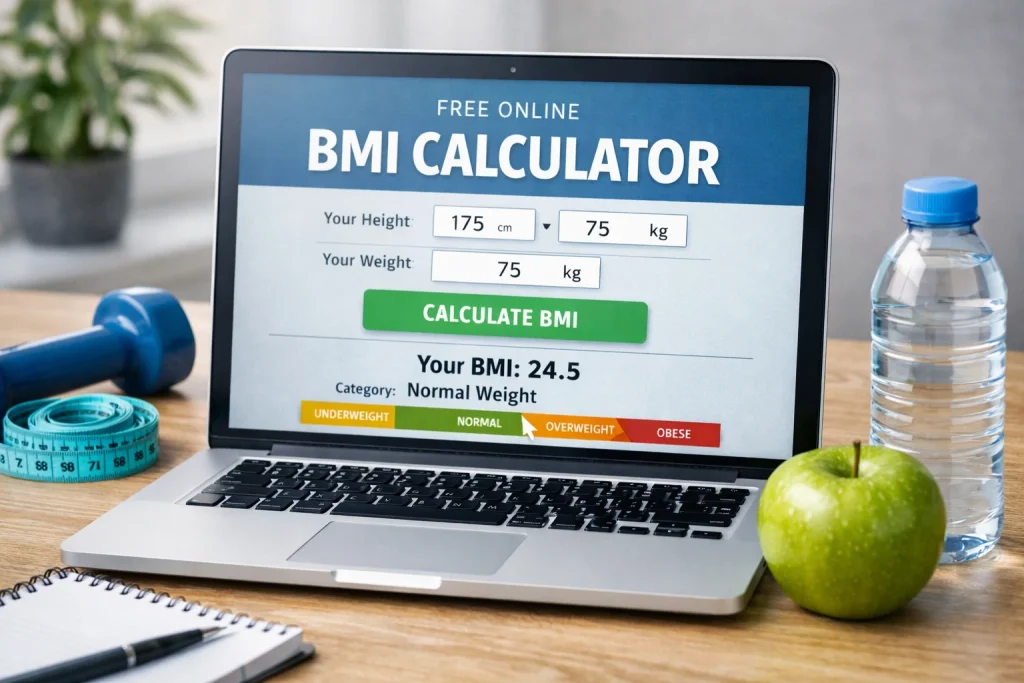
Why I Started Using a Free Online BMI Calculator — And What It Actually Told Me
I want to be upfront with you from the start — I’m not a doctor. I’m Ahsan, a web tools developer from Lahore, Pakistan. I built this platform because I genuinely believe people deserve simple, free, and accurate tools to help them make better everyday decisions.
BMI was one of the first tools I added to this site, and it’s still one of the most used. Not because it’s perfect — it isn’t — but because it gives you something valuable that most people don’t have: a starting point.
In this post, I’ll explain what BMI really means, how our free online calculator works, and most importantly, how to use the result without overthinking it.
What Exactly Is BMI?
BMI stands for Body Mass Index. At its core, it’s a simple comparison between your weight and your height. The formula divides your weight in kilograms by your height in meters squared.
You don’t need to remember the formula. That’s what the calculator is for.
What you do need to understand is what the result means — and what it doesn’t mean. BMI is a screening number. Think of it the way you think of a thermometer reading. If your temperature is high, it doesn’t tell you exactly what’s wrong. But it tells you something is worth paying attention to.
BMI works the same way.
The Four BMI Categories — Explained Simply
After you calculate your BMI, your result will fall into one of four ranges:
Under 18.5 — Underweight This may indicate your body isn’t getting enough nutrition to maintain healthy weight. It doesn’t automatically mean something is wrong, but it’s worth noting especially if it drops over time.
18.5 to 24.9 — Normal Weight This is the range most health organizations consider healthy for average adults. If you fall here, your weight and height are in a balanced proportion.
25 to 29.9 — Overweight Slightly above the normal range. This is often the stage where lifestyle habits — activity level, diet, sleep — begin to matter most. Small changes here can make a big difference.
30 and Above — Obese This range is associated with higher health risks including heart disease and diabetes according to medical research. It’s not a label — it’s a signal that your body may benefit from medical attention and lifestyle changes.
How To Use Our Free BMI Calculator
Using the tool is straightforward:
Go to our BMI Calculator page → Enter your height → Enter your weight → Click Calculate → Read your result.
It takes about 10 seconds. No account needed. No data stored. Your numbers stay between you and your browser — that’s a promise we keep.
What BMI Won’t Tell You — And Why That Matters
This part is just as important as knowing your number.
BMI does NOT measure body fat directly. It uses weight, which includes muscle, bone, water and fat together. This means a professional athlete can show as “overweight” on a BMI scale simply because muscle weighs more than fat.
BMI also does NOT account for age, gender differences in body composition, pregnancy, or genetics.
So please — never use BMI as your only health indicator. Use it as one piece of a larger picture. Pair it with how you feel physically, your energy levels, your sleep quality, and if needed, a conversation with your doctor.
Who Should Use This Tool
This calculator is useful for most adults who want a quick health check. It’s particularly helpful for:
- Students tracking fitness progress
- Working professionals who sit most of the day
- Anyone starting a new health or weight management routine
- People who want a simple baseline before speaking with a nutritionist
It is NOT designed for children (who need age-specific percentile charts), pregnant women, or people with specific medical conditions. For those groups, please consult a qualified healthcare professional directly.
My Personal Take on BMI
When I built this tool, I tested it on myself first. My result wasn’t alarming but it wasn’t comfortable either. It sat in the “overweight” range — not by a lot, but enough to make me think.
I didn’t panic. I didn’t start a crash diet. I just started paying attention to small things. Walking more. Drinking more water. Reducing late-night eating. Nothing extreme.
A few months later I checked again. The number had shifted — in the right direction.
That’s the real value of this tool. Not the number itself. The awareness it creates.
Use BMI Alongside Our Other Free Tools
For a more complete health picture, I’d recommend combining your BMI result with our other tools:
- Height & Weight Calculator — Find your ideal weight range based on height and gender
- Food Cure Hub — Learn about foods that support health naturally
- Unit Converter — Easily convert between kg/lbs and cm/ft for accurate input
Each tool gives you a slightly different view. Together they give you something much more useful.
Frequently Asked Questions
How accurate is an online BMI calculator? It’s mathematically accurate — it uses the exact same formula that medical professionals use. The limitation isn’t the math, it’s what BMI itself can and can’t measure.
Can men and women use the same calculator? Yes. The standard BMI formula is the same for adult men and women, though body fat distribution differs naturally between genders.
How often should I check my BMI? Once every 4 to 6 weeks is more than enough. Checking daily is unnecessary since normal weight fluctuations can mislead you.
My BMI shows overweight but I exercise regularly. Is something wrong? Not necessarily. High muscle mass can push BMI into the “overweight” range even for very fit individuals. If this applies to you, BMI alone isn’t the right tool — consider a body fat percentage measurement instead.
What should I do after seeing my result? Use it as a starting point, not a final verdict. If you’re in a healthy range, keep doing what you’re doing. If you’re outside it, focus on sustainable lifestyle changes — and speak with a healthcare professional if you have any concerns.
⚠️ Health Disclaimer
All information provided in this article and through the BMI calculator on this site is for general educational purposes only. It is not intended as medical advice, diagnosis, or treatment. BMI results are a screening indicator and should not replace a consultation with a qualified healthcare professional. Always seek the advice of your doctor or other qualified health provider with any questions you may have regarding a medical condition or health goal.
About The Author
Written by Ahsan — Founder of I Love Online Tool, based in Lahore, Pakistan. Ahsan is a digital tools developer and educational content writer who builds free, practical online utilities for students, professionals, and everyday users. All content on this platform is written and reviewed personally by Ahsan for accuracy, clarity, and usefulness. This article is for educational purposes and does not constitute medical advice.
📧 support@iloveonlinetool.com | 🌐 iloveonlinetool.com