
📱 Digital Distraction Cost Calculator
See how much “potential wealth” you lose annually to social media & app scrolling — turn time into real money.
The Hidden Tax on Your Brain: Calculate What Digital Distraction Is Really Costing You
One Tuesday Morning That Changed How I Work
It was 9:14 AM.
I had coffee. I had a plan. I sat down to write a report that should have taken maybe ninety minutes. At 12:47 PM, I looked up, groggy and vaguely guilty, and realized I had written exactly one paragraph. One. The rest of those three hours? A blur of Twitter threads, a YouTube video about the history of concrete that I genuinely cannot explain, two Slack rabbit holes, and about forty-seven phone checks for notifications that amounted to nothing.
The report? Due at 1 PM.
That day cost me — not just in panic and a late submission, but in something harder to measure. Reputation. Mental energy. I had to work for two hours after dinner to make up for it. The sleep I lost.
I never actually added it up. Most of us don’t.
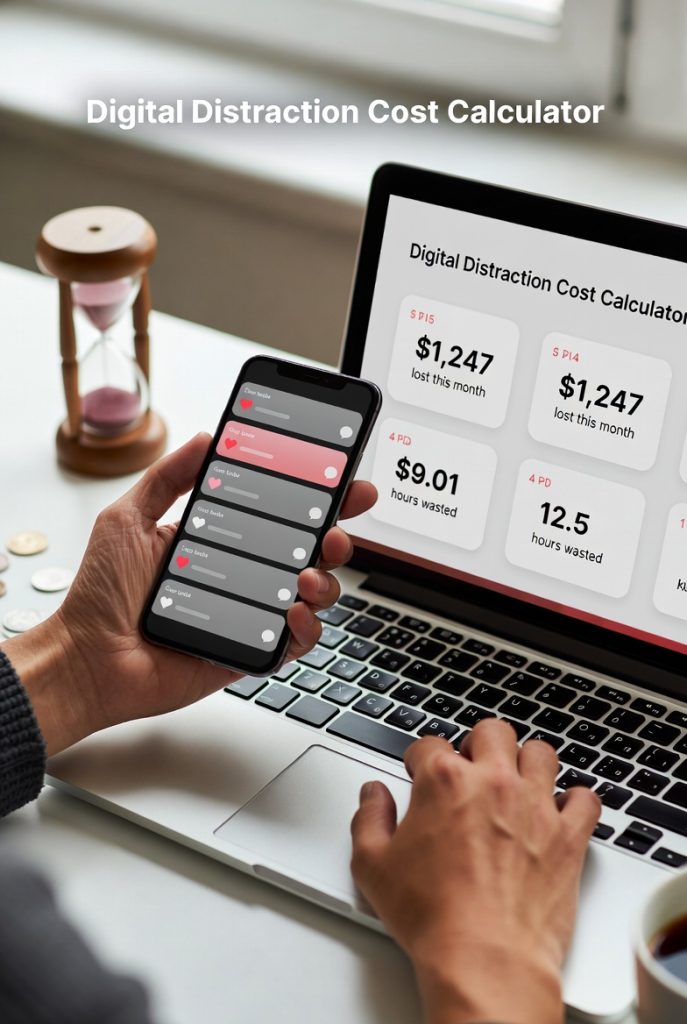
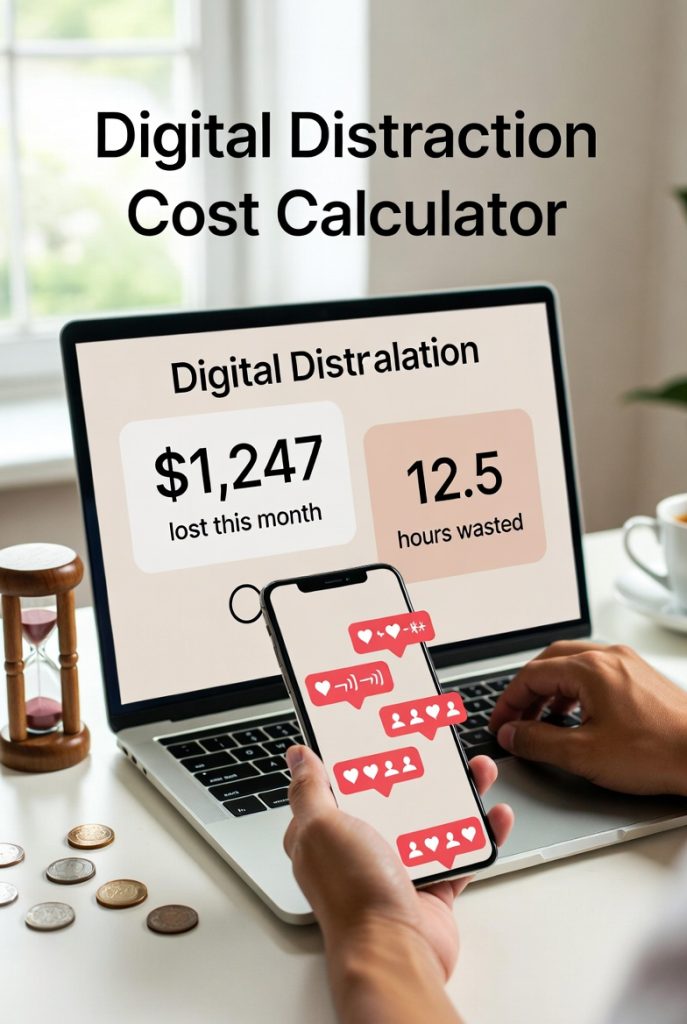
That’s exactly what the Digital Distraction Cost Calculator at iloveonlinetool.com does. It adds it up. Brutally, precisely, and in a way that’s genuinely hard to look away from.
Why Nobody Talks About the Real Price Tag
Here’s the thing about distraction. It doesn’t feel expensive. It feels free.
Checking Instagram for “two minutes” costs nothing, right? Glancing at your phone during a meeting — what’s the harm? Reading one more article before you start the actual work? That’s just warming up, surely.
No. It’s not.
The science on this is old and damning and still largely ignored. A 2004 study out of UC Irvine — and it’s been replicated since — found that after an interruption, the average worker takes 23 minutes and 15 seconds to fully return to their original task. Not the task itself. The cognitive state required to do the task well.
Read that again.
Twenty-three minutes. For one notification. For one Slack ping. For one “quick” phone check.
If you’re interrupted four times in a workday — which is laughably conservative — that’s roughly ninety minutes of recovery time that simply disappears. It’s not logged anywhere. It doesn’t show up on your timesheet. Your boss doesn’t see it. You barely feel it. You just end the day exhausted, having produced far less than you intended, and blaming yourself for laziness that was never really laziness at all.
It was theft. Quiet, consensual, habitual theft — and you handed over the keys.
What the Digital Distraction Cost Calculator Actually Does
Most productivity tools tell you to stop being distracted. Good luck with that.
This tool does something more honest. It shows you what you’ve already lost — in time, in money, in cognitive bandwidth — and then lets you decide what that number means to you.
When you enter your data, the calculator processes three things that most people never connect:
Your hourly value. Whether you’re salaried, freelance, or a student measuring opportunity cost — every hour has a worth. The calculator helps you define yours.
Your distraction frequency. How many times per hour are you interrupted — or do you interrupt yourself? Be honest. Most people say three or four. The actual number, when tracked, is usually closer to seven or eight.
Your recovery lag. Using research-backed estimates of attention recovery time, the tool calculates not just the minutes spent distracted, but the invisible “recovery tax” that follows each interruption.
The result isn’t a vague warning. It’s a dollar figure. A weekly loss. A yearly projection. The kind of number that makes you sit back in your chair and go oh.
That’s the point.
The Neuroscience Nobody Told You About
Your brain doesn’t multitask. I know you believe it does. It doesn’t.
What you’re actually doing when you “multitask” is called task-switching — and every switch has a cost. Psychologists call it the “switch cost.” It’s real, it’s measurable, and it accumulates across your day like interest on debt.
Every time your attention fractures — a notification sound, a conversation nearby, a browser tab you “just quickly” check — your prefrontal cortex has to rebuild the mental workspace it just had. It’s like closing a complex document and reopening it. The file is still there, but Windows takes a moment to render it again. Your brain takes twenty-three minutes.
The apps on your phone know this. They were designed with input from behavioral psychologists whose entire job was to make leaving difficult. The red notification badge? Deliberately chosen. The infinite scroll? Engineered. The variable reward of a refresh — sometimes interesting content, sometimes not — is structurally identical to a slot machine.
You’re not weak. You’re playing against a billion-dollar machine specifically tuned to beat you.
The Digital Distraction Cost Calculator doesn’t shame you for that. It just quantifies it. Because when you see the number, the abstraction collapses. It becomes real. And real things can be changed.
5 Ways Digital Distraction Is Costing You More Than You Think
1. The Deep Work Deficit
Cal Newport popularized this term, but the concept is ancient. The work that actually moves your life forward — creative thinking, strategic planning, genuine skill-building — requires sustained focus. Ninety minutes minimum, ideally. Distraction doesn’t just interrupt that work. It makes it impossible. The calculator shows you exactly how many hours of potential deep work you’ve surrendered per week.
2. The Income Gap
For freelancers and business owners, this is visceral. If your billable hour is worth $75, and you lose 90 minutes of productive capacity daily to distraction, that’s $112.50 per day. $562.50 per week. Nearly $30,000 per year. Vanished. Into notification purgatory.
3. The Quality Collapse
Distracted work isn’t just slower. It’s worse. Errors go up. Creativity tanks. The kind of insight that makes your work genuinely good — the unexpected connection between two ideas — only surfaces in states of focused attention. Fragmented attention produces fragmented output.
4. The Mental Load
Every unfinished task you got distracted from sits in your working memory as an “open loop.” Psychologists call this the Zeigarnik effect. These loops drain cognitive energy even when you’re not actively thinking about them. By evening, you’re depleted — not from working hard, but from carrying the weight of a dozen things you started and didn’t finish.
5. The Compounding Career Cost
This one’s long-term and largely invisible. The person who does deep, high-quality, undistracted work consistently gets better faster. They develop rare skills. They build a reputation for reliability. Over a career of five or ten years, the gap between a distracted professional and a focused one isn’t 10% — it’s categorical. Different opportunities. Different income bands. Different levels of respect.
The calculator doesn’t project a decade out. But the daily number it shows you? Multiply it in your head. Let it land.
How to Use the Calculator — Step by Step
Step 1: Enter Your Hourly Rate. Don’t skip this. If you’re salaried, divide your annual salary by 2,080 (standard working hours per year). If you’re a student, use your target hourly rate or the cost of your tuition per hour of class. Every hour has value. Name it.
Step 2: Log Your Distraction Frequency. How many times per hour do you check your phone, switch tabs, or respond to a non-urgent notification? Be honest. Track it for one real hour before entering this number if you can — most people are shocked.
Step 3: Add Your Work Hours Per Day. The tool needs this to project daily, weekly, and annual loss figures.
Step 4: Hit Calculate. Your results appear immediately. You’ll see your daily cost, weekly cost, and annual cost in both time and money. There’s also a “focus potential” figure — how much value you could recover by cutting distraction by just 50%.
Step 5: Set One Target. The tool suggests a micro-goal based on your results. Not “stop being distracted forever.” Just one specific, achievable change — like a 45-minute phone-free block each morning. Small friction, significant recovery.
Who Needs This Tool Right Now
Remote Workers who’ve lost the external structure of an office and can’t figure out why they feel so exhausted despite “working all day.” Spoiler: busyness and productivity are not the same thing.
Freelancers and Creatives who bill by the hour and suspect — correctly — that distraction is eating directly into their income. Seeing the dollar figure is usually the wake-up call that habit-change advice never quite delivers.
Students who’ve noticed that three-hour study sessions produce far less than they should. The calculator reframes the conversation from discipline to design — showing them that the problem isn’t effort, it’s environment.
Managers and Team Leads who want to make the business case for no-meeting mornings, Slack quiet hours, or focus sprints. This tool gives them numbers, not just philosophy.
The Bigger Picture: Reclaiming Your Attention Economy
Here’s an uncomfortable opinion: attention is now the most valuable resource in the world. Not oil. Not data. Attention.
Every platform, every app, every notification is competing for yours — because your attention, sold to advertisers, is how most of the internet makes money. Your focus is the product. You are the mine being worked.
The Digital Distraction Cost Calculator is a small act of reclamation. It takes an invisible drain and makes it visible. It converts a vague feeling of wasted potential into a concrete number that belongs to you — your hours, your income, your career trajectory.
And when something is concrete, you can actually do something about it.
The future of productive, meaningful work isn’t about willpower. It’s about awareness. It’s about designing your environment with the same intentionality that apps were designed to capture you. The calculator is the first honest measurement. Everything else — the habits, the boundaries, the routines — follows from seeing the truth clearly.
Start there.
Interesting FAQ
Is digital distraction actually measurable in financial terms? Yes — and the methodology is straightforward. Time lost to distraction, multiplied by your hourly value, gives you a direct financial figure. The Digital Distraction Cost Calculator uses peer-reviewed research on attention recovery times to build in the “hidden” recovery cost that most people never account for, making the estimate far more accurate than a simple time-tracking approach.
How much does the average worker lose to distraction per year? Research estimates vary, but credible studies suggest the average knowledge worker loses between 2.1 and 2.5 hours of productive time daily to distraction and the cognitive recovery that follows it. At median knowledge-worker wages in the US, that translates to somewhere between $15,000 and $28,000 in lost productive value annually — per person.
Does reducing distraction actually improve the quality of work, or just the speed? Both — and this is important. Speed is the obvious metric. But cognitive research consistently shows that focused attention produces qualitatively superior output: more creative connections, fewer errors, deeper analytical thinking. The work you do in 90 distraction-free minutes is genuinely different from the work done in 90 fragmented minutes. Different in kind, not just quantity.
What’s the single most effective change someone can make based on their results? The research is remarkably consistent on this: a phone-free morning block of 60–90 minutes produces the highest ROI. Not because mornings are magic, but because willpower and cognitive glucose are highest early in the day, and protecting that window compounds over time. The calculator suggests personalized micro-goals, but if you want one universal answer — that’s it.
Is this problem really getting worse, or does it just feel that way? It is genuinely getting worse. Screen time data from the past decade shows a consistent upward trend across all age groups. The average adult in 2024 checks their phone over 144 times per day — roughly once every six to seven minutes during waking hours. The apps driving this behavior are updated constantly with new retention mechanisms. Awareness of the problem has grown, but the infrastructure pulling against focus has grown faster.
Can this calculator help with academic productivity, or is it mainly for professionals? Absolutely for students. The hourly value can be calculated as tuition cost per study hour, or as opportunity cost against a target career income. The distraction patterns in academic settings — social media during study sessions, phone proximity during lectures — are well-documented, and the cognitive recovery research applies identically. Several universities have begun using tools like this in student orientation programs focused on academic performance.