
The first time someone told me my blog post “lacked E-E-A-T,” even that person asked me do you know what is E-E-A-T SEO? I nodded along like I knew exactly what they meant. I didn’t. I went home, searched the term, and fell straight into a swamp of jargon-heavy articles that explained the acronym using more acronyms. An hour later I knew it had something to do with quality, and absolutely nothing about what I was supposed to actually do.
If that’s where you are right now — hearing E-E-A-T thrown around in SEO circles and quietly wondering if everyone else got a memo you missed — you’re in good company. It’s one of those terms that gets repeated far more often than it gets explained clearly.
Here’s the good news: once you strip away the SEO-consultant mystique, E-E-A-T is genuinely simple. It’s not a secret algorithm or a hidden score. It’s a common-sense way of asking, “should people trust this content?” — and once it clicks, it changes how you write for the better.
So let me give you the version I wish I’d found on day one: a plain-English guide to what E-E-A-T actually is, why Google cares, and what it means for you as a blogger trying to get found and build a real audience.
What Is E-E-A-T in SEO? The Simple Definition
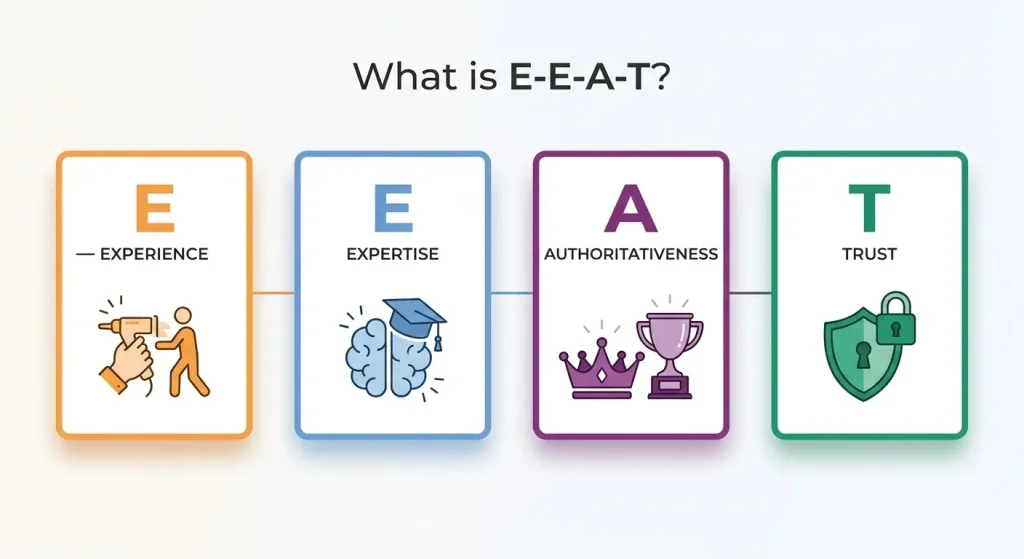
Let’s answer the core question right away. E-E-A-T in SEO stands for Experience, Expertise, Authoritativeness, and Trust. It’s a framework Google uses to judge the quality of content and the people and sites behind it — essentially a structured way of asking whether a page is reliable, useful, and worth showing to searchers.
The term comes straight from Google’s own Search Quality Rater Guidelines, a lengthy document Google gives to the real humans it hires to evaluate search results. Those raters don’t change rankings directly, but they assess whether content demonstrates these four qualities, and Google uses their feedback to shape and test its ranking systems. So E-E-A-T isn’t a button or a dial inside the algorithm — it’s a concept that guides what “good” looks like.
That distinction trips up a lot of bloggers, so hold onto it: E-E-A-T describes the qualities Google wants high-ranking content to have, rather than being a single score Google assigns your page. The practical effect is the same — content that genuinely demonstrates experience, expertise, authority, and trust tends to do better over time — but understanding the difference keeps you from chasing a number that doesn’t exist.
With the definition settled, let’s break down each letter, because the real value is in understanding what they individually ask of you.
Breaking Down the Four Letters
Each letter of E-E-A-T captures a different angle on “can we trust this?” Here’s what each one actually means in practice.
Experience
Experience asks a deceptively powerful question: has the creator actually done or used the thing they’re writing about? A review of a hiking backpack written by someone who hauled it up an actual mountain carries a weight that a spec-sheet summary never will. First-hand experience — “I tried this, here’s what happened” — is something Google increasingly values, especially for reviews, tutorials, and personal topics.
Expertise
Expertise is about knowledge and skill in the subject. It’s the depth that shows you actually understand what you’re talking about, whether that comes from formal training or years of hands-on practice. Importantly, expertise looks different by topic — a medical article expects credentialed expertise, while a recipe blog expects a skilled, experienced home cook, not a doctorate.
Authoritativeness
Authoritativeness is about reputation — are you, or your site, a recognized go-to source on this topic? It’s built over time through other people referencing you, linking to you, and treating you as a reliable voice. Authority is less about what you say about yourself and more about how the wider web and your field regard you.
Trust
Trust is the big one — and Google itself says it’s the most important member of the family, sitting at the center of the whole framework. Trust asks whether your content is accurate, honest, safe, and reliable. A page can show experience, expertise, and authority, but if it isn’t trustworthy — if it’s misleading, unsafe, or deceptive — the rest doesn’t matter.
The key insight is that these four aren’t equal partners. Trust is the destination; experience, expertise, and authority are the roads that lead there. Everything you do for E-E-A-T ultimately serves the goal of being trustworthy.
The Extra E: Why Google Added “Experience” in 2022
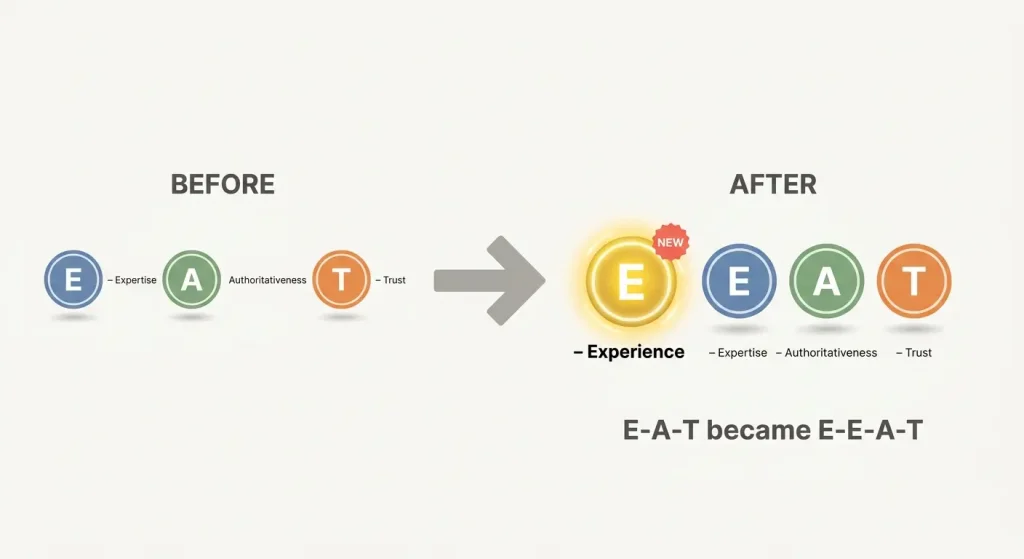
If you’ve been around SEO for a while, you might remember when this was just “E-A-T” — three letters, not four. That’s not a typo in old articles; the framework genuinely changed.
In December 2022, Google updated its Quality Rater Guidelines and added the second E — Experience — turning E-A-T into E-E-A-T. The reasoning was sensible: for many topics, whether the creator has genuine first-hand experience is just as telling as their formal expertise. Sometimes more so. The person who actually owned the gadget, visited the restaurant, or lived through the situation often produces more useful content than a detached expert who only researched it.
This change quietly rewarded exactly the kind of content many bloggers are naturally good at: authentic, personal, “I actually did this” writing. If you’ve ever felt outgunned by big sites with credentialed authors, the addition of Experience is, in a way, good news for you — your real, lived perspective is a legitimate quality signal.
The non-obvious takeaway is that Google was formalizing something it had always implicitly valued. Experience didn’t suddenly start mattering in 2022; Google just made it explicit, signaling to creators that first-hand insight is a distinct and valuable thing, not just a flavor of expertise.
Is E-E-A-T a Ranking Factor? The Honest Answer
This is where I have to be careful and honest, because there’s a lot of confident misinformation floating around.
E-E-A-T is not a direct ranking factor in the way that, say, page speed or mobile-friendliness can be measured and fed into an algorithm. Google representatives have stated repeatedly that there’s no single “E-E-A-T score” the system calculates for your page. You cannot optimize a specific number, because that number doesn’t exist. Anyone selling you a guaranteed “E-E-A-T score boost” is overselling.
What actually happens is subtler. Google builds ranking systems and then uses human quality raters — guided by E-E-A-T — to judge whether those systems are surfacing genuinely good results. The raters’ assessments help Google calibrate and improve its algorithms. So E-E-A-T influences rankings indirectly, by shaping what Google trains its systems to reward, rather than by acting as a direct input.
The practical upshot for you is reassuring: you don’t need to game a hidden metric. You need to genuinely be the kind of source E-E-A-T describes. When you create content that real experts and experienced people would respect, you’re aligning with the same target Google’s algorithms are chasing. Chase the substance, not the acronym, and the rankings tend to follow.
What Is YMYL, and How It Connects to E-E-A-T
You can’t fully understand E-E-A-T without meeting its close companion: YMYL. The two are deeply linked.
YMYL stands for “Your Money or Your Life” — Google’s label for topics that could significantly impact a person’s health, financial stability, safety, or overall well-being. Think medical advice, financial guidance, legal information, and major life decisions. If bad information on a topic could genuinely harm someone, it’s probably YMYL.
Here’s the connection: E-E-A-T matters most for YMYL topics. Google holds content about your health or money to a far higher standard than content about, say, the best way to fold a t-shirt. A flawed t-shirt-folding tip is harmless; flawed cancer or investment advice can ruin lives. So for YMYL subjects, Google leans heavily on E-E-A-T signals to make sure it’s surfacing genuinely trustworthy sources.
For bloggers, this distinction is strategically important. If you write in a YMYL niche — health, finance, legal, safety — you’ll need to clear a much higher bar for expertise, sourcing, and trust than someone in a hobby niche. It’s not impossible, but it demands serious credibility. If your niche is lower-stakes, the E-E-A-T bar is real but more forgiving, and your authentic experience can carry more of the weight.
Why E-E-A-T Matters for Bloggers and AdSense
Let’s get concrete about why you, specifically, should care — because this isn’t just abstract Google theory.
First, visibility. Content that demonstrates genuine E-E-A-T tends to perform better in search over the long run, especially as Google’s helpful-content systems increasingly reward people-first, trustworthy writing and filter out thin, generic content. If you want sustainable organic traffic rather than a flash in the pan, building real E-E-A-T is one of the most durable investments you can make.
Second, monetization. If you run ads through programs like Google AdSense, content quality and trust matter for approval and for staying in good standing. AdSense and Google’s broader policies favor original, helpful, people-first content and look unkindly on thin, low-value, or deceptive pages. Strong E-E-A-T and AdSense-friendliness pull in the same direction — the qualities that make Google trust your content are largely the qualities that make it ad-program-friendly too.
The deeper point is that E-E-A-T isn’t a tax you pay to please an algorithm — it’s a description of what makes content genuinely good for humans. Readers who trust you come back, subscribe, share, and convert. Optimizing for E-E-A-T and optimizing for a real, loyal audience turn out to be almost the same project. That alignment is why it’s worth taking seriously rather than treating as a box to tick.
How to Actually Improve Your Site’s E-E-A-T
Enough theory — here’s what you can do, practically, starting today. None of this requires a credential or a big budget; it requires intention.
Show Real Experience
Write from first-hand experience wherever you can, and make it visible. Use specific details, real examples, original photos, and honest “here’s what actually happened” moments. Generic advice anyone could have written from a quick search is exactly what Google’s helpful-content systems are designed to demote. Your lived perspective is your edge — use it.
Build Clear Author Identity
Give your content a real, identifiable author with a genuine bio explaining who they are and why they’re qualified to write on the topic. An author box, an about page, and consistent bylines all signal that real, accountable people stand behind your work. Anonymous content struggles to build trust.
Cite Sources and Back Up Claims
Support factual claims with reputable sources, link out to authoritative references, and be transparent about where your information comes from. For any statistic or claim, ask yourself “how do I know this, and can I show the reader?” Linking to primary sources, like official documentation, strengthens trust rather than sending readers away.
Strengthen Trust Signals
Make your site trustworthy in the obvious, boring ways: a clear about page, working contact information, transparent policies, secure HTTPS, accurate content, and prompt corrections when you get something wrong. These unglamorous basics are foundational to the “T” that sits at the heart of E-E-A-T.
Keep Content Accurate and Updated
Review and refresh older posts so they stay correct and current. Outdated, neglected content quietly erodes trust, while regularly maintained content signals that a real, attentive person stands behind the site. Accuracy isn’t a one-time achievement — it’s ongoing maintenance.
The thread tying all of this together is sincerity. Every tactic here is really just a way of being a more credible, helpful source rather than appearing to be one. Do these things genuinely, and the E-E-A-T signals take care of themselves.
You Should Must Read Most Relevant Thing About: E-E-A-T Signals List: 25 Factors Google’s Quality Raters Look For (and How I Check Each One)
Common E-E-A-T Myths, Cleared Up
This topic attracts a lot of confident nonsense. Let me clear up the misconceptions I hear most.
Myth: “E-E-A-T is a score you can optimize”
It isn’t. There’s no E-E-A-T number in the algorithm to push up. It’s a conceptual framework that quality raters use and that Google’s systems indirectly reflect. Chase genuine quality, not a phantom metric.
Myth: “You need formal credentials to have E-E-A-T”
Not necessarily. For many non-YMYL topics, demonstrated experience and skill matter more than a degree. A passionate, experienced hobbyist can absolutely show strong E-E-A-T in their niche. Credentials help most in high-stakes YMYL fields.
Myth: “E-E-A-T only matters for big sites”
False. Small and new blogs build E-E-A-T the same way large ones do — through genuine experience, clear authorship, accuracy, and trust signals. You won’t have the authority of an established giant overnight, but the framework rewards sincerity at any size.
The pattern behind every myth is the same temptation: to treat E-E-A-T as a trick to be gamed rather than a quality to be earned. Once you drop that framing, most of the confusion disappears.
How to Check Your Content’s E-E-A-T
Here’s a practical problem: E-E-A-T is easy to understand but hard to judge in your own writing, because you’re too close to it. You know your own expertise, so your content feels trustworthy to you — but that’s not how a first-time reader, or Google, sees it.
This is exactly where running your draft through an objective check helps. A content-audit tool like iloveonlinetool.com is built for this — you paste in your article and instantly see how helpful, original, and people-first it looks to Google and AdSense, with a read on the four E-E-A-T signals, YMYL sensitivity, readability, SEO essentials, and policy risks. It turns the fuzzy question “does this have E-E-A-T?” into something you can actually see and act on before you hit publish.
I’m a big believer in this kind of pre-publish gut-check, because the gap between “I know my stuff” and “my content visibly demonstrates that I know my stuff” is where so many good bloggers lose out. An honest audit catches the missing author bio, the unsupported claim, the thin section — the small gaps that quietly undercut trust. Fixing those before publishing is far easier than wondering later why a solid post never ranked.
Whatever tool or process you use, the principle holds: review your content through the reader’s skeptical eyes, not your own confident ones. That shift in perspective is most of the battle.
E-E-A-T and AI-Written Content: What’s Changed
Since so many bloggers now lean on AI tools to draft content, it’s worth addressing how E-E-A-T applies, because this is where a lot of sites quietly get into trouble.
Google’s stated position is that it rewards helpful, people-first content regardless of how it’s produced — it doesn’t ban AI outright. What it targets is low-value, unoriginal, mass-produced content created primarily to rank rather than to genuinely help readers. The how matters far less than the result: is this content useful, original, and trustworthy, or is it filler?
This is exactly where E-E-A-T becomes a sharp dividing line for AI-assisted blogs. AI can help you draft, structure, and edit — but it cannot supply your first-hand Experience, your genuine Expertise, your earned Authority, or the Trust that comes from a real, accountable author. Those are the very things that distinguish content worth ranking from the flood of generic AI output Google is actively trying to filter out.
The practical lesson is that AI raises the stakes on E-E-A-T rather than lowering them. If anyone can generate a competent-sounding article in seconds, the signals that can’t be faked — real experience, real credibility, real trust — become your only durable advantage. Use AI as a tool if you like, but make sure what you publish carries the human signals a machine can’t manufacture. That’s also precisely the kind of gap a pre-publish content audit is good at catching.
My Honest Take
After years of writing and watching the SEO conversation churn, my honest view is that E-E-A-T is one of the few SEO concepts that’s actually good for the web, not just good for gaming Google. Most ranking advice ages badly. “Be genuinely trustworthy and write from real experience” never will.
What frustrates me is how the term got over-complicated. E-E-A-T became a buzzword consultants could charge for, wrapped in mystique to make it sound like arcane knowledge. Strip that away and it’s almost embarrassingly intuitive: show you know what you’re talking about, prove you’ve actually done it, build a reputation, and be honest. We’d give a friend the same advice for earning anyone’s trust, online or off.
If I have one piece of real-talk for bloggers, it’s this: stop trying to “do E-E-A-T” as a separate task bolted onto your content. Instead, become the kind of source it describes. Write the post only you could write, with the details only you know, backed by sources you actually checked, under a name you’re willing to stand behind. Do that consistently and you’ll never have to worry about the acronym again — you’ll simply embody it.
The blogs that win over the next decade won’t be the ones that gamed a framework. They’ll be the ones run by real people who genuinely earned their readers’ trust. E-E-A-T is just Google’s attempt to find those people. Make yourself easy to find.
FAQ
What is E-E-A-T in SEO?
E-E-A-T stands for Experience, Expertise, Authoritativeness, and Trust. It’s a framework from Google’s Search Quality Rater Guidelines used to judge content quality and the credibility of the people and sites behind it. Trust is considered the most important of the four.
What does the extra E in E-E-A-T stand for?
The added E stands for Experience, introduced in December 2022 when Google updated E-A-T to E-E-A-T. It reflects whether a creator has genuine first-hand experience with the topic — something Google values highly, especially for reviews and personal subjects.
Is E-E-A-T a Google ranking factor?
Not directly. There’s no single E-E-A-T score in the algorithm. Instead, human quality raters use E-E-A-T to evaluate results, and Google uses that feedback to shape its ranking systems. So it influences rankings indirectly by defining what “good” content looks like.
What is YMYL and how does it relate to E-E-A-T?
YMYL means “Your Money or Your Life” — topics affecting health, finances, safety, or well-being. E-E-A-T matters most for YMYL content, because inaccurate information on these subjects can cause real harm, so Google holds it to a much higher standard.
Do I need credentials to have good E-E-A-T?
Not always. For high-stakes YMYL topics, formal expertise matters a lot. But for many other niches, demonstrated experience and genuine skill can matter more than credentials — an experienced hobbyist can show strong E-E-A-T in their field.
How can I improve my blog’s E-E-A-T?
Write from first-hand experience, add clear author bios, cite reputable sources, strengthen trust signals like an about page and accurate content, and keep posts updated. Essentially, genuinely be a credible, helpful source rather than just appearing to be one.
How do I check if my content has good E-E-A-T?
Because you’re too close to your own work to judge it, an objective content-audit tool helps. Pasting your draft into a checker that scores E-E-A-T signals, readability, and policy risks shows you the gaps — like a missing bio or unsupported claim — before you publish.
I Hope you wanna get more information in detail about – what SEMrush Says About This Google E-E-A-T: What it is & how it affects SEO.
Conclusion
So, what is E-E-A-T in SEO? It’s Google’s framework for content quality — Experience, Expertise, Authoritativeness, and Trust — with Trust at its heart. It comes from Google’s quality rater guidelines, it isn’t a direct ranking score you can game, and it matters most for high-stakes YMYL topics. For bloggers, it’s the difference between content that earns lasting visibility and content that quietly disappears.
The reassuring truth is that E-E-A-T rewards exactly what good blogging was always supposed to be: honest, experienced, knowledgeable writing from real people who stand behind their work. You don’t need to trick an algorithm — you need to be genuinely worth trusting, and then make that trustworthiness visible on the page.
Here’s your action step: take your most important blog post and run it through an honest E-E-A-T check today — you can paste it straight into iloveonlinetool.com to see how it stacks up on the four signals, readability, and policy risks. Fix the gaps it surfaces, then make that review a habit before you publish anything. Your readers — and your rankings — will thank you for it.
About the Author
“M – Hassan Ali — AdSense + SEO Expert Guidance Provider” is a content strategist and blogger who has spent years writing about SEO, content quality, and the realities of growing an audience from scratch. They focus on translating Google’s ever-shifting guidance into plain-English advice that ordinary bloggers can actually use, without the jargon or the hype. When not auditing content or untangling the latest search update, they’re usually testing these ideas on their own projects to make sure the advice holds up in practice.